Plumbing Estimating Services in Georgia
Remote plumbing takeoffs and cost estimating for projects in Georgia. Share the project jurisdiction, current drawings, specifications, and bid deadline to confirm scope and delivery. This service-area page does not represent a local office.
What do commercial plumbing estimating services in Georgia involve?
Commercial plumbing estimating services in Georgia deliver CSI Division 22 material takeoffs, MCAA labor productivity modeling, and subcontractor tender preparation. Estimators calibrate scopes to the Georgia State Minimum Standard Plumbing Code (IPC with DCA state amendments), local sewer authority backflow rules (City of Atlanta Watershed Management, Gwinnett DWR), and regional soil conditions from Metro Atlanta red clay to coastal sandy alluvium.
Georgia Takeoff Scope Verification Checklist
Confirm the project jurisdiction in Georgia
Remote estimating starts with the project address and issued documents. A service-area name does not determine the permit authority, utility requirements, wage basis or actual site conditions.
For the areas discussed here, including Fulton County, Gwinnett County, Cobb County, identify the authority and utility serving the actual parcel rather than applying a statewide assumption.
- Share the permit cover sheet or designer’s code summary, adopted edition and local amendment references.
- Provide utility connection details, meter/backflow selections and the civil-to-building package handoff.
- Use project geotechnical and engineered details for burial, excavation, soil protection and restraint quantities.
- Identify public/private funding and the applicable wage determination before supplying labor rates.
Regional code, soil and wage descriptions on this page require project-specific verification. They are not a permit approval, site survey or published local labor quotation.
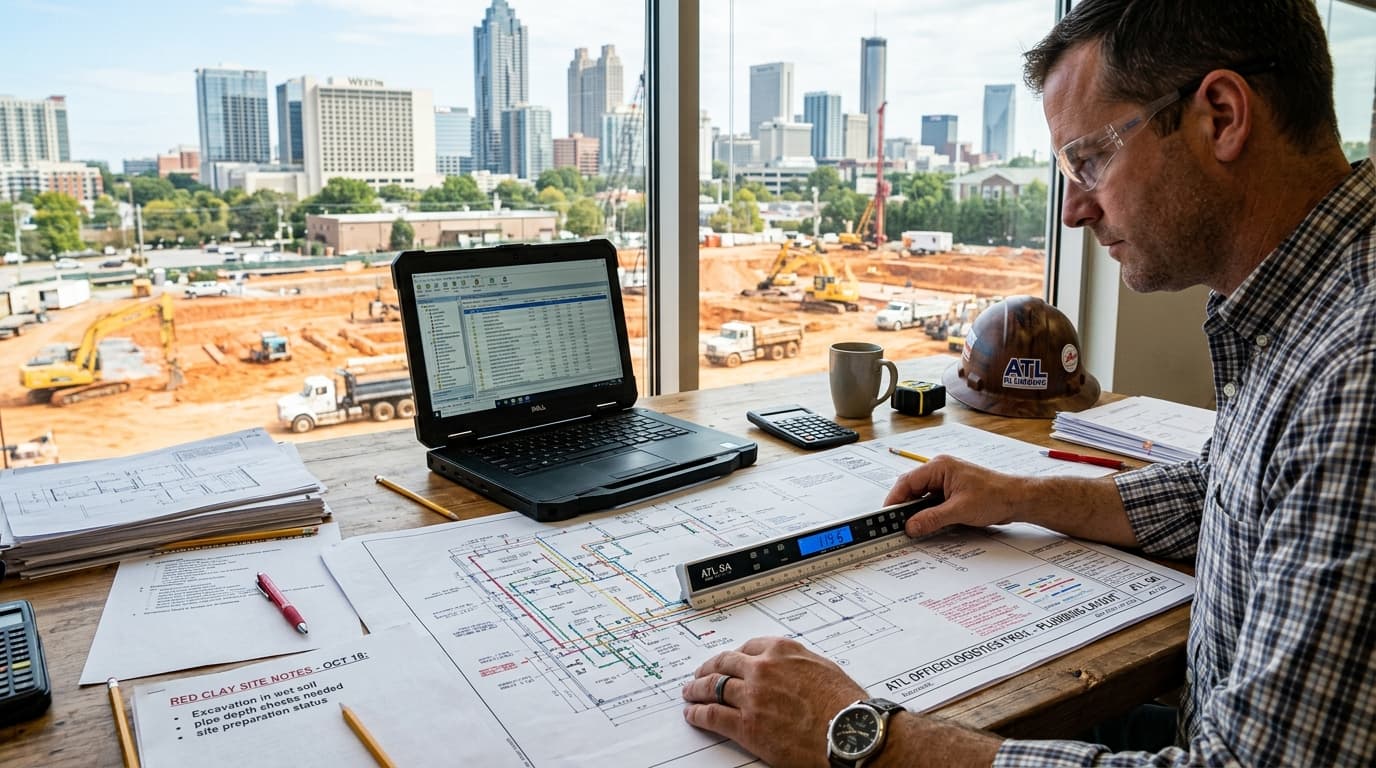
Images illustrate estimating subjects. They do not document our local office, a completed client project or local jobsite experience.
- ICC code adoption information and IAPMO adopted-code information
- Federal wage determination records; confirm any separate state/local requirements with the relevant authority.
- Reconcile civil and building plumbing plans
- Send the jurisdiction and drawings for a scope review
Quick State Facts • Georgia Estimating Baselines
Georgia State Minimum Standard Plumbing Code (2018/2021 International Plumbing Code with DCA Georgia State Amendments)
Georgia Department of Community Affairs (DCA)
Statewide Master Plumber (Class I restricted, Class II unrestricted) and Journeyman Plumber licensing under O.C.G.A. Title 43, Chapter 14
Mandatory state minimum standard enforced by municipal and county building departments (e.g., City of Atlanta City Planning, Fulton County, Gwinnett County)
Regional frost penetration depth typically ranges from 6 to 12 inches across Metro Atlanta and North Georgia, to 0 to 6 inches in Central and Coastal Georgia; local AHJ ordinances govern exterior water line depth of bury
Metro Atlanta (Fulton, Gwinnett, Cobb, DeKalb, Clayton Counties), Savannah Logistics & Maritime Corridor (Chatham County), Augusta Healthcare & Cyber Hub (Richmond County), Columbus Metroplex (Muscogee County), Macon / Central Georgia Commercial Hub
Georgia Plumbing Code & Regulatory Environment
Commercial plumbing in the State of Georgia is regulated under the Georgia State Minimum Standard Plumbing Code, codified in O.C.G.A. § 8-2-20 et seq., administered by the Georgia Department of Community Affairs (DCA).
State Adoption Structure
Georgia adopts the model International Plumbing Code (IPC) with state-specific amendments approved by the DCA Board. The state minimum standard code applies in every municipality and county across Georgia.
State vs. Local AHJ Authority
Local jurisdictions enforce the state code through local municipal inspectors. Localities may adopt local administrative amendments, but cannot alter the technical plumbing provisions without formal DCA approval.
Key Statutory Plumbing Requirements:
- Contractors must operate under a licensed Master Plumber (Class II unrestricted for commercial work) licensed by the Georgia Secretary of State.
- Commercial plumbing permits and plan reviews required by local municipal building inspection departments.
- Cross-connection backflow prevention containment assemblies required on all commercial domestic services.
- Storm drainage sizing calculated based on local rainfall intensity data (typically 4.0 to 5.0 in/hr for 100-year storm events).
Plumbing Estimating & Takeoff Scope Considerations in Georgia
Itemized quantity takeoff protocols for commercial plumbing assemblies governed by Georgia codes.
Type L hard copper piping with soldered or mechanical press-connect fittings, commercial PEX-a distribution loops in multi-family projects, and PRV stations.
Schedule 40 PVC DWV in standard commercial builds; cast iron no-hub pipe in multi-story risers, return-air plenums, and acoustic walls.
Interior rainwater conductors, primary and overflow roof drains, vertical leaders, and connections to civil stormwater detention ponds.
Schedule 40 black steel gas piping with welded joints on 2-1/2" and larger, corrugated stainless steel tubing (CSST) for terminal runs.
Commercial water closets with 1.28 GPF flush valves, high-efficiency urinals, ADA lavatories with sensor faucets, emergency eyewash stations.
Commercial gas-fired condensing water heaters, tankless manifold arrays, thermal expansion tanks, and recirculation circulators.
Duplex domestic water booster pump skids, submersible sanitary sewage ejectors, and elevator sump pumps with oil-sensing switches.
Fiberglass pipe insulation with ASJ vapor retarder on cold water lines; thermal insulation on hot water and recirculation loops.
Trench excavation (6" to 12" cover), crushed stone bedding, laser-graded underground pipe installation, and backfill.
Regional Construction Conditions & Site Geotechnical Factors
Regional factors to confirm against the project geotechnical report, engineered details, and permit requirements.
Frost penetration averages 6 to 12 inches across Metro Atlanta and North Georgia, and 0 to 6 inches in Central and Coastal Georgia. Exterior backflow preventers require insulated hot boxes with thermostatic freeze-protection heaters.
Metro Atlanta and North Georgia feature dense, weathered Cecil red clay with low percolation, requiring crushed stone trench bedding. Coastal Georgia (Savannah, Brunswick) features loose sandy alluvium and shallow water tables.
Coastal projects and low-lying river bottomlands along the Chattahoochee and Savannah rivers require trench box shoring and temporary wellpoint dewatering allowances.
Georgia is situated in low seismic hazard zones (Category A and B), minimizing rigid sway bracing costs. Acidic red clay soils mandate protective polywrap on buried ductile iron lines.
Metro Atlanta features extensive plumbing supply house networks; rural projects in south Georgia require material staging coordination and freight freight buffers.
Local Jurisdiction & Project Coverage Matrix
Commercial takeoff considerations across Georgia's key economic centers, county seats, and metropolitan AHJs.
| Area / Market | Primary AHJ or Authority | Local Code / Amendment | Utility Considerations | Major Project Types | Estimating Considerations | Verification Source |
|---|---|---|---|---|---|---|
| Metro Atlanta (Fulton & DeKalb Counties) | City of Atlanta Department of City Planning / Fulton County Building Inspections | Georgia State Minimum Standard Plumbing Code with Local Admin Rules | City of Atlanta Department of Watershed Management (DWM) capacity fees | Commercial high-rises, corporate headquarters, multi-family towers, data centers | DWM sewer capacity fees; high-capacity booster pumps; acoustic cast iron in high-rises; UA Local 72 rates | City of Atlanta City Planning / DWM Standards |
| Gwinnett County (Lawrenceville / Duluth / Norcross) | Gwinnett County Department of Planning and Development | Georgia State Minimum Standard Plumbing Code | Gwinnett County Department of Water Resources (DWR) grease interceptor rules | Commercial retail centers, corporate tech parks, distribution warehouses | Strict pre-treatment grease trap sizing; Cecil red clay bedding; siphonic roof drainage | Gwinnett County Planning & Development / DWR |
| Cobb County (Marietta / Kennesaw / Smyrna) | Cobb County Community Development Agency | Georgia State Minimum Standard Plumbing Code | Cobb County Water System (CCWS) cross-connection control | Office developments, entertainment centers (The Battery), healthcare facilities | CCWS backflow containment assemblies; rock trenching allowances in northwest Cobb | Cobb County Community Development |
| Savannah / Coastal Georgia (Chatham County) | City of Savannah Development Services / Chatham County Building Safety | Georgia State Minimum Standard Plumbing Code | City of Savannah Water Resources / Local utility districts | Intermodal port logistics warehouses, historic commercial retrofits, hospitality | Shallow groundwater dewatering; coastal corrosion-resistant hangers; lift stations; UA Local 188 rates | City of Savannah Development Services |
| Augusta-Richmond County Metroplex | Augusta Planning & Development Department | Georgia State Minimum Standard Plumbing Code | Augusta Utilities Department (AUD) | Medical college healthcare facilities, cybersecurity campuses, manufacturing | NFPA 99 medical gas piping; industrial process waste neutralization tanks | Augusta Planning & Development / AUD |
Labor Environment & Prevailing Wage Considerations
How commercial mechanical contractors model labor productivity and regulatory wage determinations in Georgia.
Georgia is a right-to-work state under O.C.G.A. § 34-6-20 et seq. State-funded public projects do not require state prevailing wages.
Private commercial and municipal public works projects operate in a competitive open-shop contracting environment.
Federal government construction projects (Fort Moore, Fort Eisenhower, Robins AFB, Moody AFB, VA hospitals) require compliance with federal Davis-Bacon wage rates.
United Association locals (UA Local 72 Atlanta, UA Local 188 Savannah) maintain strong representation on major commercial towers, industrial manufacturing facilities, and healthcare campuses.
Summer humidity and heat between June and August require productivity adjustments for outdoor utility trenching and unconditioned site rough-ins.
State-Specific Plumbing Estimating Workflow in Georgia
The 9-step preconstruction process mechanical estimators follow to produce audit-ready bid deliverables.
Review architectural floor plans, civil site drawings, and Division 22 plumbing specifications.
Verify compliance with the Georgia State Minimum Standard Plumbing Code (DCA amendments to the IPC).
Itemize all commercial plumbing fixtures, carrier assemblies, commercial water heaters, and booster pumps.
Quantify linear footage of domestic water, sanitary DWV, storm conductors, and natural gas lines by size and spec.
Calculate excavation, crushed stone bedding, and compaction testing for Metro Atlanta Piedmont red clay.
Apply competitive commercial open-shop rates or Davis-Bacon wage determinations for federal work.
Obtain current local plumbing wholesale quotes for pipe, valves, fittings, and specialized equipment packages.
Clearly document trade cutoffs (e.g. 5 feet outside building wall, mechanical equipment connections).
Compile itemized Bill of Materials, labor hour summaries, and subcontractor proposal letters for GC submission.
Frequently Asked Questions • Georgia Plumbing Estimating
Q:What plumbing code is enforced in Georgia for commercial estimating?
Commercial plumbing in Georgia is governed statewide by the Georgia State Minimum Standard Plumbing Code, which is based on the International Plumbing Code (IPC) with state amendments adopted by the Department of Community Affairs (DCA).
Q:Who regulates commercial plumbing contractor licensing in Georgia?
Commercial plumbing contractor licensing is governed by the State Construction Industry Licensing Board, Division of Master and Journeyman Plumbers, under the Georgia Secretary of State (O.C.G.A. Title 43 Chapter 14).
Q:What is the required frost depth in Georgia for plumbing takeoffs?
Frost penetration typically ranges from 6 to 12 inches across Metro Atlanta and North Georgia, to 0 to 6 inches in Central and Coastal Georgia, subject to local AHJ verification.
Q:Does Georgia require prevailing wages on commercial plumbing projects?
Georgia does not have a state prevailing wage law. Private commercial and municipal public works operate under competitive market open-shop rates, while federal government projects require Davis-Bacon wage determinations.
Q:What drawings are needed for an accurate Georgia commercial plumbing estimate?
Estimators require architectural floor plans, civil site utility plans, plumbing fixture schedules, riser isometric diagrams, structural foundation drawings, and Division 22 written specifications.
Request a Detailed Plumbing Estimate in Georgia
Submit your drawing set and specifications. We review civil utility tie-ins, riser isometric diagrams, and local AHJ codes to provide an itemized Bill of Materials and MCAA labor estimate on the agreed schedule.
Bidding Commercial Work in Georgia?
We prepare complete CSI Division 22 takeoff packages formatted for quick review and direct bid day submission.
Instant Quote Calculator
Estimate your Georgia project turnaround and pricing.
Share your scope and bid deadline. Pricing and delivery dates are confirmed after drawing review.