Plumbing Estimating Services in Texas
Accurate commercial and industrial quantity takeoffs across Texas: TSBPE board rules, Houston UPC vs DFW IPC code variances, expansive clay soil void modeling, and Texas Chapter 2258 prevailing wage rates.
Remote estimating for projects in this service area. This page does not represent a local office. Confirm the applicable code edition, amendments, and utility requirements with the project designer and authority having jurisdiction.
How Does Commercial Plumbing Estimating in Texas Differ from National Standards?
Estimating in Texas differs due to: 1) The split-code municipal landscape where Houston and Austin enforce the 2021 Uniform Plumbing Code (UPC) while DFW and San Antonio enforce the 2021 International Plumbing Code (IPC), 2) High-plasticity Blackland Prairie expansive clay soils requiring carton void forms and sleeved penetrations, 3) Hill Country limestone rock-chopping excavation premiums, 4) Heavy industrial trade waste interceptors, and 5) Texas Chapter 2258 prevailing wage rules.
Confirm the project jurisdiction in Texas
Remote estimating starts with the project address and issued documents. A service-area name does not determine the permit authority, utility requirements, wage basis or actual site conditions.
- Share the permit cover sheet or designer’s code summary, adopted edition and local amendment references.
- Provide utility connection details, meter/backflow selections and the civil-to-building package handoff.
- Use project geotechnical and engineered details for burial, excavation, soil protection and restraint quantities.
- Identify public/private funding and the applicable wage determination before supplying labor rates.
Regional code, soil and wage descriptions on this page require project-specific verification. They are not a permit approval, site survey or published local labor quotation.
Images illustrate estimating subjects. They do not document our local office, a completed client project or local jobsite experience.
- ICC code adoption information and IAPMO adopted-code information
- Federal wage determination records; confirm any separate state/local requirements with the relevant authority.
- Reconcile civil and building plumbing plans
- Send the jurisdiction and drawings for a scope review
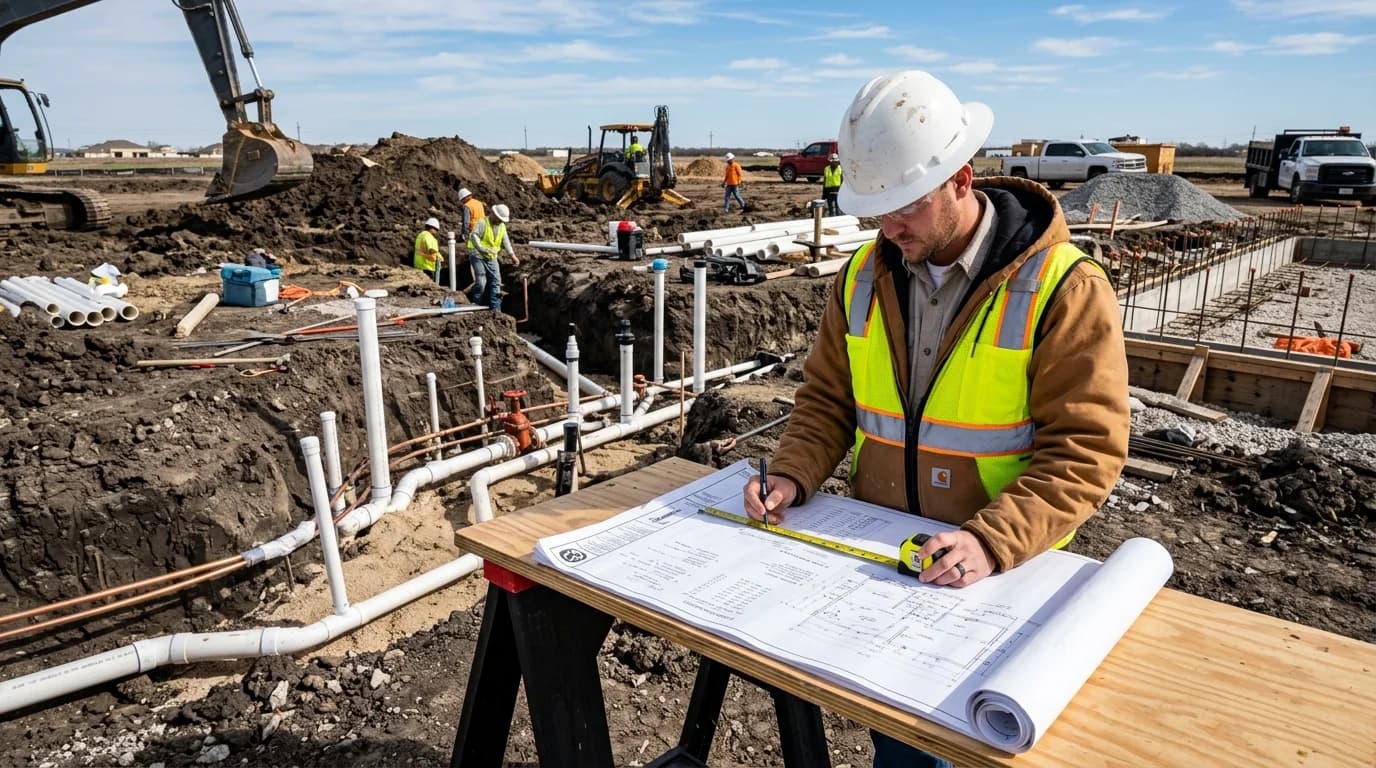
The Texas Dual-Code Reality: Houston UPC vs. DFW IPC
[ESTIMATING PRACTICE] Unlike states with a unified commercial building code, Texas grants home-rule authority to municipalities to adopt their model plumbing code of choice.
While the Texas State Board of Plumbing Examiners (TSBPE) enforces licensing qualifications for Master Plumbers and Journeymen statewide, mechanical estimating requires knowing the local model code: Houston and Austin enforce the Uniform Plumbing Code (UPC), while Dallas, Fort Worth, Arlington, and San Antonio enforce the International Plumbing Code (IPC). Pipe sizing curves, fixture unit allocations, and venting rules vary considerably between these systems.
Texas Major Metro Plumbing Code Variances Compared
[MUNICIPAL SPECIFICATIONS] Preconstruction takeoffs must calibrate material pipe sizing to the local municipal code base:
| Metro Jurisdiction | Model Code & Agency | Drainage & Gas Specifications | Takeoff & Estimating Impact |
|---|---|---|---|
| City of Houston & Harris County | 2021 Uniform Plumbing Code (UPC) Houston Public Works / Building Code Enforcement Amendments | UPC drainage fixture unit (DFU) sizing; developed length gas tables; cast iron or Schedule 40 PVC; heavy-duty exterior storm detention. | UPC fixture unit sizing curves, local Houston grease trap formula (minimum 750–1,500 gallon precast concrete), heavy storm water pump vaults. |
| Dallas / Fort Worth (DFW Metroplex) | 2021 International Plumbing Code (IPC) North Central Texas Council of Governments (NCTCOG) Regional Amendments | IPC fixture unit load calculations; Schedule 40 PVC DWV permitted; specialized blackland expansive clay grade beam sleeves. | IPC fixture count tables, cleanout spacing every 100 feet, carton void forms below suspended slab-on-grade plumbing, NCTCOG regional amendments. |
| City of Austin & Travis County | 2021 Uniform Plumbing Code (UPC) City of Austin Development Services Department Amendments | Dual-piped non-potable reclaimed purple piping; rainwater harvesting detention tie-ins; sub-metering on commercial units. | Mandatory auxiliary rainwater harvesting integration on commercial developments, enhanced reclaimed water plumbing, strict Austin Water sub-metering rules. |
| City of San Antonio & Bexar County | 2021 International Plumbing Code (IPC) City of San Antonio Development Services & SAWS Standards | Standard IPC DWV with heavy Edwards Aquifer sensitive containment requirements; double check / RPZ backflow. | Edwards Aquifer recharge zone backflow containment rules, local utility SAWS (San Antonio Water System) connection standards, limestone trench rock chopping. |
Texas Expansive Soils: Void Boxes & Grade Beam Sleeves
[GEOTECHNICAL WATCHPOINT] The Texas Blackland Prairie (running through DFW, Waco, Temple, Austin, and San Antonio) features highly active montmorillonite clay soils with Plasticity Indexes (PI) exceeding 35 to 50:
When seasonal moisture fluctuates, these soils heave and drop up to 4 to 6 inches, which will shear rigid sub-slab plumbing lines clean off grade beams.
Our estimators verify structural foundation sheets to budget corrugated cardboard carton void forms beneath grade beams, oversized schedule 40 PVC penetration sleeves with Link-Seal modular seals, and stainless steel flexible braided expansion couplings on all building entrance utilities.
Central Texas Hill Country: Limestone Rock Excavation Modeling
[CIVIL TRENCHING SPECIFICATION] While Houston soils are soft alluvial clays, Central Texas (Austin, San Antonio, New Braunfels, San Marcos) sits atop hard Edwards limestone:
Excavating sewer laterals at 1/8" or 1/4" per foot slope through solid limestone cannot be done with standard backhoe buckets. The takeoff must factor hourly equipment rental rates for 10,000-lb hydraulic rock-breaking hammers, saw-cutting, and rock-wheel trenchers.
Native crushed limestone spoils cannot be used to backfill underground PVC or copper pipes due to sharp fracture edges. Takeoffs must budget imported pea gravel or washed sand bedding (minimum 6 inches below and 12 inches above pipe springline).
Texas Public Works: Chapter 2258 Prevailing Wage Compliance
[PUBLIC WORKS LEGAL MANDATE] For plumbing subcontractors bidding educational facilities (K-12 ISDs, Texas A&M, UT System), city municipal utilities, or county jails, compliance with Texas Government Code Chapter 2258 is mandatory:
Public bodies must enforce local prevailing wage schedules (frequently adopting federal Davis-Bacon determinations for the county).
Our 10-Step Texas Commercial Takeoff Process
Confirm the following review steps in the agreed Texas estimating scope:
Examine architectural drawings, civil utility profiles, geotechnical soils reports, and CSI Division 22 plumbing specifications to isolate municipal code boundaries.
Verify whether the project operates under UPC (Houston, Austin) or IPC (DFW, San Antonio, El Paso) to apply correct fixture unit sizing and venting rules.
Calibrate digital drawing scales in Bluebeam Revu using verified architectural structural grid lines across all floor plans and underground utility sheets.
Audit soils reports for Plasticity Index (PI > 35). Quantify carton void forms, grade beam penetration sleeves, and flexible expansion joints for expansive clay soils.
Itemize all commercial plumbing fixtures, emergency eyewashes, grease interceptors, commercial gas water heaters, and booster pump skids from Division 22 schedules.
Measure sub-slab sanitary DWV, storm sewer laterals, and grease waste lines, calculating required slope, backfill aggregate, and machine excavation volumes.
Quantify domestic cold water, hot water, recirculating loops, and natural gas lines, applying developed length formulas and pressure drop calculations.
Count isolation ball valves, PRVs, RPZ backflow preventers, water hammer arrestors, and clevis pipe hangers or trapeze supports.
Apply baseline MCAA labor benchmarks adjusted for Texas weather conditions, deep trench excavation, and Chapter 2258 public works prevailing wages.
Compile a turnkey tender package complete with itemized CSI Division 22 Excel workbooks, visual Bluebeam PDF markups, and bid qualification letters.
Texas Commercial Construction Sectors We Estimate
Semiconductor & Advanced Manufacturing
High-purity polypropylene PVDF loops, specialized acid neutralization waste systems, process cooling water connections, and ultra-clean gas manifolds.
Austin Tech Corridor, Sherman Silicon Strip, DFW TelecomPetrochemical & Refinery Industrial Facilities
Heavy-duty schedule 80 chemical piping, explosion-proof emergency showers, API oil-water separators, and TCEQ environmental compliance.
Houston Ship Channel, Baytown, Beaumont, Corpus ChristiHigh-Bay Logistics & Distribution Centers
Large-diameter siphonic roof storm drainage systems, exterior retention pond tie-ins, truck maintenance sand interceptors, and high-bay fixtures.
DFW Airport Logistics, South Dallas I-20, Houston NorthwestHealthcare & Life Science Campuses
Texas Department of State Health Services (DSHS) hospital compliance, medical gas manifolds, pure water RO systems, and patient room batteries.
Texas Medical Center (Houston), UT Southwestern (Dallas), Austin HealthcareHigh-Rise Commercial & Corporate Headquarters
Multi-stage domestic booster pump packages, intermediate PRV pressure break stations, core restroom carriers, and executive shower suites.
Downtown Houston, Uptown Dallas, The Domain AustinMulti-Family Residential Developments
Repetitive bathroom pod and kitchen rough-in matrices, domestic hot water recirculation balancing, sub-metering stations, and acoustic drain insulation.
San Antonio Suburban, Fort Worth North, Frisco / Plano, KatyTop 5 Estimating Pitfalls in Texas & Our Mitigations
Houston UPC vs DFW IPC Fixture Unit Sizing Errors
Estimator Mitigation: The Uniform Plumbing Code (Houston/Austin) sizes drainage stacks and water distribution using different DFU/WSFU curves than the International Plumbing Code (DFW/San Antonio). Bidding IPC pipe diameters in Houston causes immediate plan review failure.
Expansive Clay Soil Foundation Movement Failure
Estimator Mitigation: Texas Blackland Prairie and Gulf Coast clay soils exhibit massive swell/shrink cycles. Under-slab plumbing must carry cardboard void boxes, grade beam penetration sleeves, and flexible expansion couplings to prevent shear failure.
Limestone Trench Rock-Chopping Omission in Hill Country
Estimator Mitigation: Excavation in Austin, San Antonio, and Central Texas hits solid Edwards limestone within 12 inches of grade. Estimators must include hydraulic rock-chopping hammers and tracked hoe excavation premiums in civil takeoffs.
Precast Concrete Grease Interceptor Under-Sizing
Estimator Mitigation: Texas municipal utilities (e.g. City of Houston Chapter 47) enforce strict retention-time formulas requiring 1,000 to 2,000 gallon grease traps. Assuming undersized indoor point-of-use units leads to major contractor backcharges.
Texas Government Code Chapter 2258 Prevailing Wage Violations
Estimator Mitigation: Public projects (ISDs, universities, TxDOT, municipal buildings) legally mandate certified payroll and published prevailing wage determinations. Takeoffs must apply verified wage schedules and certified fringe rates.
Frequently Asked Questions: Texas Commercial Plumbing Estimating
Q:What plumbing code governs commercial construction across Texas?
Texas does not have a single statewide building code enforced by a central agency. Instead, the Texas State Board of Plumbing Examiners (TSBPE) oversees plumber licensing, while individual municipalities adopt either the Uniform Plumbing Code (UPC) or the International Plumbing Code (IPC) with extensive local amendments. For example, Houston and Austin enforce the 2021 UPC, whereas Dallas, Fort Worth, and San Antonio enforce the 2021 IPC.
Q:How does the dual-code (UPC vs IPC) system impact commercial plumbing estimates in Texas?
[REGIONAL SPECIFICATION] The dual-code system directly alters pipe sizing, fixture counts, and material allowances. UPC jurisdictions calculate drainage using strict developed-length curves and require larger pipe diameters for high fixture loads, while IPC jurisdictions permit air admittance valves (AAVs) under engineered conditions and feature different water supply fixture unit (WSFU) diversity factors.
Q:Why must expansive clay soils be accounted for in Texas sub-slab plumbing takeoffs?
[GEOTECHNICAL REQUIREMENT] The Texas Blackland Prairie (extending from DFW down through Austin and San Antonio) and coastal Houston soils contain high-plasticity montmorillonite clay that swells and shrinks dramatically with moisture changes. Underground pipe takeoffs must budget carton void boxes beneath grade beams, oversized PVC sleeves with elastomeric seals, and flexible expansion loops to protect pipes from slab movement.
Q:What are Texas Government Code Chapter 2258 prevailing wage requirements?
Under Texas Government Code Chapter 2258, public entities (such as Independent School Districts, Texas A&M/UT universities, and city utilities) require contractors to pay workers not less than the prevailing wage rate for the locality. Estimators must price burdened hourly wage rates that include mandatory apprentice-to-journeyman ratios, overtime premiums, and certified payroll reporting.
Q:How does Hill Country limestone rock excavation affect plumbing utility estimates?
[EXCAVATION SPECIFICATION] In the Texas Hill Country (Austin, San Antonio, New Braunfels, Round Rock), solid limestone rock is encountered within 6 to 18 inches of the surface. Trenching for sewer laterals, water lines, and storm drains requires specialized hydraulic hammer attachments, rock trenchers, and imported aggregate fill, increasing utility trenching costs by 200% to 350% compared to sandy loam.
Q:What plans and documents are required to prepare an accurate Texas commercial plumbing takeoff?
We require digital PDF drawing sets: 1) Architectural Plans (floor layouts, reflected ceiling plans, wall chase dimensions), 2) Civil Site Plans (utility tie-ins, invert elevations, retention basin connections), 3) Geotechnical Soils Reports (soil plasticity index and rock depth), and 4) Division 22 Plumbing Sheets (underground rough-in, riser diagrams, fixture schedules, and gas piping schematics).
Share your drawing link, scope, and bid deadline. Fees and delivery dates are confirmed after review.
Bidding a Commercial Plumbing Project in Texas?
From Houston UPC vs DFW IPC compliance to expansive clay void modeling and Chapter 2258 prevailing wage takeoffs, get fully audited Texas plumbing estimates.