Plumbing Estimating Services in New York
Statewide commercial quantity takeoffs and preconstruction cost modeling: 2022 NYC Plumbing Code, DOB NOW filings, DEP backflow rules, Upstate 60-inch frost depth site utilities, and NYS Article 8 prevailing wages.
Remote estimating for projects in this service area. This page does not represent a local office. Confirm the applicable code edition, amendments, and utility requirements with the project designer and authority having jurisdiction.
How Does Commercial Plumbing Estimating in New York Differ from National Standards?
Estimating in New York differs due to: 1) The dual regulatory framework dividing the 2022 NYC Plumbing Code (Local Law 126) from the 2020 Uniform Code of NYS, 2) Complete prohibition of combustible plastic DWV (PVC) in NYC Type I & II commercial high-rises mandating no-hub cast iron, 3) NYC DEP cross-connection backflow permits (GEN-215B), 4) Upstate 48-to-60-inch freeze depth civil utility trenching, and 5) Strict Article 8 / NYC Comptroller 220 prevailing wage benefit burdens.
Confirm the project jurisdiction in New York
Remote estimating starts with the project address and issued documents. A service-area name does not determine the permit authority, utility requirements, wage basis or actual site conditions.
- Share the permit cover sheet or designer’s code summary, adopted edition and local amendment references.
- Provide utility connection details, meter/backflow selections and the civil-to-building package handoff.
- Use project geotechnical and engineered details for burial, excavation, soil protection and restraint quantities.
- Identify public/private funding and the applicable wage determination before supplying labor rates.
Regional code, soil and wage descriptions on this page require project-specific verification. They are not a permit approval, site survey or published local labor quotation.
Images illustrate estimating subjects. They do not document our local office, a completed client project or local jobsite experience.
- ICC code adoption information and IAPMO adopted-code information
- Federal wage determination records; confirm any separate state/local requirements with the relevant authority.
- Reconcile civil and building plumbing plans
- Send the jurisdiction and drawings for a scope review
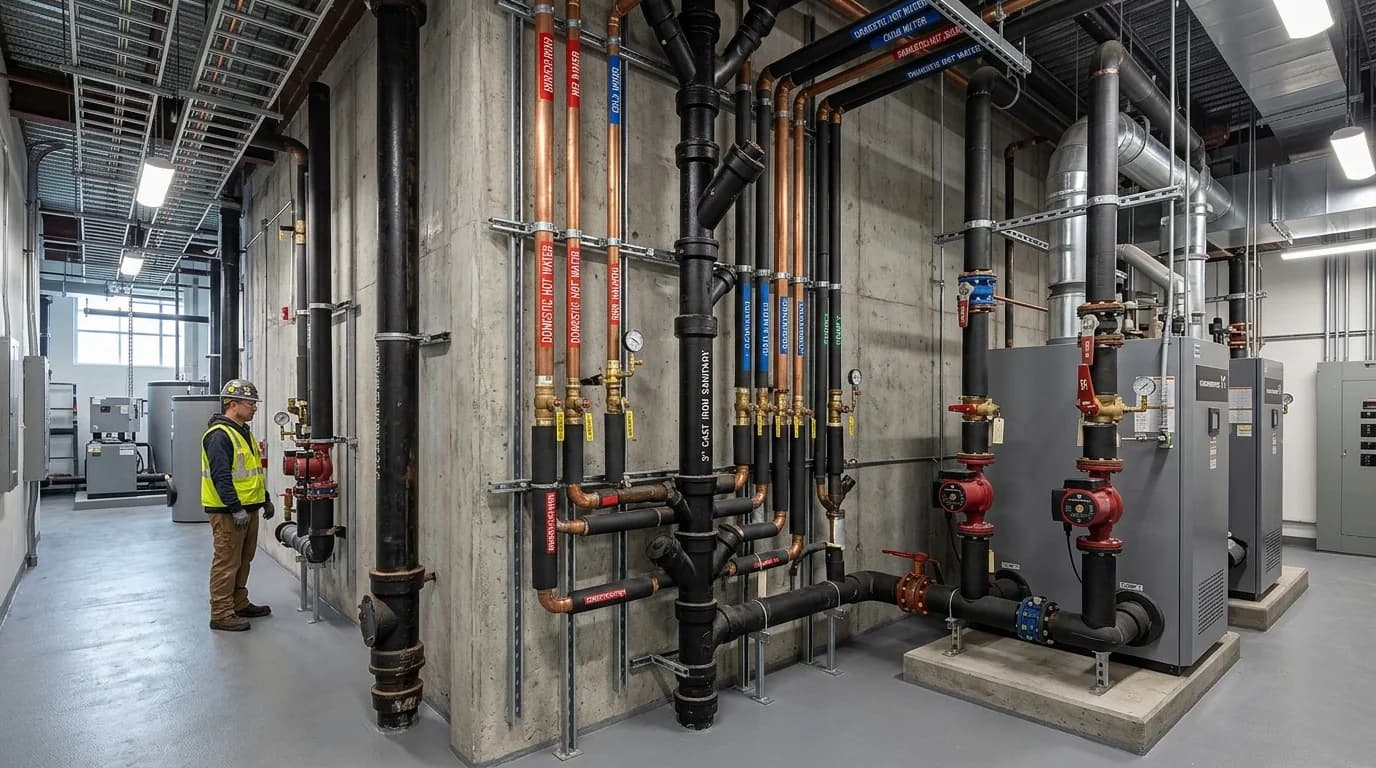
NYC DOB vs. NY State Uniform Code: Key Takeoff Differences
[ESTIMATING PRACTICE] Treating New York State as a single uniform code jurisdiction is one of the most expensive bidding errors a commercial contractor can make.
New York City (the five boroughs of Manhattan, Brooklyn, Queens, the Bronx, and Staten Island) operates under its own distinct administrative and technical legal framework: the 2022 NYC Construction Codes administered by the NYC Department of Buildings (DOB). Outside NYC, projects are governed by the Uniform Code of New York State (administered by the NYS Department of State Division of Building Standards and Codes). Material allowances, venting rules, permitting procedures, and labor costs differ substantially between these two jurisdictions.
New York Regional Plumbing Regulatory Tiers
[STATEWIDE SPECIFICATION] Mechanical estimators must align material choices and labor assumptions with the specific regional authority:
| Regional Tier | Governing Agency & Code | Approved Drainage Specs | Preconstruction & Labor Impact |
|---|---|---|---|
| New York City (5 Boroughs) | NYC Department of Buildings (DOB) & NYC DEP 2022 NYC Plumbing Code (Local Law 126 of 2021) & DEP Rules Title 15 | Strictly Service Weight or Extra Heavy Cast Iron (CISPI 301 / ASTM A888). PVC/ABS prohibited in Type I & II buildings. | Mandatory DOB NOW filings by a licensed NYC Master Plumber (LMP). High-rise booster zoning; DEP GEN-215B backflow engineering; heavy night hoisting logistics. |
| Long Island (Nassau & Suffolk) | Town & Village Building Departments / Nassau & Suffolk Health Depts 2020 Uniform Code of NYS + Local Town Plumbing Codes (e.g., Hempstead, Brookhaven) | Schedule 40 PVC DWV permitted in low-rise commercial; cast iron required in commercial kitchens and multi-story assemblies. | High groundwater table; specialized on-site sanitary nitrogen-reducing septic systems and leaching pool fields; Article 8 Local 200 labor. |
| Westchester & Hudson Valley | County Health Departments & Municipal Building Inspectors 2020 Uniform Code of NYS (based on 2018/2021 IPC) + County Sanitary Codes | PVC Schedule 40 DWV common in standard light commercial; copper or cast iron for institutional and medical hospital centers. | Rock excavation trenching allowances for sewer mains; water treatment filtration in well-water commercial districts; Local 21 labor schedules. |
| Upstate New York (Buffalo, Rochester, Albany) | NYS Department of State (DOS) Division of Building Standards & Codes 2020 Uniform Code of New York State (IPC framework with NYS Supplements) | Schedule 40 PVC widely accepted across commercial sectors; cast iron acoustic dampening optional on high-end medical/education. | Deep winter frost protection (48 to 60 inch burial depth for civil utilities); heavy snow melt storm drainage sizing; Local 22 (Buffalo) / Local 7 (Albany) wages. |
When Cast Iron Soil Pipe is Legally Mandated in New York
[CODE COMPLIANCE] In national estimating workflows, Schedule 40 PVC DWV is frequently assumed for commercial drainage. In New York commercial construction, however, this assumption can trigger severe bid-day disqualification or crushing change orders:
In buildings of Type I and Type II non-combustible construction (which includes virtually all commercial office towers, mid-rise and high-rise multi-family developments, hospitals, higher education complexes, and hotels in NYC), combustible plastic piping is strictly prohibited for sanitary, storm, and vent piping.
Estimators must price service-weight or extra-heavy No-Hub Cast Iron soil pipe (CISPI 301 / ASTM A888) with heavy-duty four-band stainless steel shielded couplings (e.g. Husky HD 2000 or Clamp-All 80). Bidding PVC on a commercial NYC building will result in immediate plan rejection by the DOB plan examiner.
Upstate New York Winter Freeze Depth & Site Utility Engineering
[REGIONAL CLIMATE STANDARD] While Downstate New York typically requires a 36-to-42-inch frost burial depth, Upstate New York (Albany, Saratoga, Syracuse, Rochester, Buffalo, and the North Country) experiences sustained sub-zero winter temperatures.
NYS Uniform Code and municipal water authorities mandate that exterior domestic and fire service lines carry a minimum of 4.5 to 5.0 feet of earth cover. Takeoffs must budget deep mechanical trenching, benching, certified trench shoring boxes, and washed stone pipe bedding.
Exposed parking garage drainage conductors, unconditioned loading dock risers, and rooftop storm headers require self-regulating heat trace cable (minimum 5 to 8 watts/ft) and closed-cell elastomeric insulation with weatherproof protective aluminum jacketing.
High-Rise Water Booster Zoning & NYC DEP Backflow Approvals
[HIGH-RISE ENGINEERING] Vertical piping infrastructure in New York City towers introduces specialized preconstruction cost centers that suburban takeoffs never encounter:
Municipal street water pressure in NYC averages 40 to 55 PSI. Structures taller than 4 stories require variable-frequency drive (VFD) booster packages. Under NYC PC 604.8, fixture pressure cannot exceed 80 PSI, requiring intermediate pressure-reducing valve (PRV) stations and express distribution loops every 6 to 8 floors.
The NYC Department of Environmental Protection mandates that all commercial and industrial service entrances feature approved RPZ containment backflow preventers. The estimator must budget dedicated professional engineering filing fees and certified testing costs associated with DEP Form GEN-215B.
NYS Article 8 Prevailing Wages & Urban Logistical Burdens
[LABOR CALIBRATION] Pricing labor in the New York market demands granular regional adjustment:
Our 10-Step New York Commercial Takeoff Process
Confirm the following review steps in the agreed New York estimating scope:
Examine architectural floor plans, civil utility profiles, reflected ceiling plans (RCP), and CSI Division 22 plumbing manuals to isolate regional code boundaries.
Verify whether the project falls under NYC DOB (Local Law 126) or NYS Uniform Code to establish approved pipe materials, venting schemes, and permit fees.
Calibrate digital drawing scales in Bluebeam Revu using verified architectural structural grid dimensions across all floor plans and vertical riser diagrams.
Quantify exterior water mains and gravity sewer laterals, applying 48 to 60 inch upstate frost depth burial allowances or NYC DEP roadway restoration fees.
Itemize all commercial plumbing fixtures, emergency eyewashes, grease interceptors, water softeners, and packaged booster systems from Division 22 schedules.
Measure pipe runs by individual system (domestic cold water, hot water, recirc, DWV, roof storm, natural gas) and quantify all fittings and cleanouts.
Count isolation ball valves, PRVs, backflow assemblies (RPZ), water hammer arrestors, and seismic sway bracing or high-rise vertical stack riser clamps.
Incorporate urban logistical premiums: off-hours material deliveries, vertical hoist window limitations, sidewalk shed permits, and tight plenum constraints.
Apply baseline MCAA labor benchmarks adjusted for local union prevailing wages (NYC Local 1, Nassau Local 200, Albany Local 7, Buffalo Local 22) or open-shop markets.
Compile a turnkey tender package complete with itemized CSI Division 22 Excel workbooks, visual Bluebeam PDF markups, and bid qualification letters.
New York Commercial Building Sectors We Estimate
From Manhattan skyscrapers to Upstate industrial centers, our estimators calibrate takeoffs to specific building types:
Commercial High-Rise & Office Towers
Multi-zone domestic booster pumping, intermediate PRV pressure break vaults, vertical cast iron stack expansion loops, and core restroom banks.
Manhattan, Long Island City, Downtown Brooklyn, White PlainsHealthcare & Life Science Facilities
NYS DOH Article 28 compliance, pure water deionized loops, acid waste neutralization systems, clinical sink vacuum breakers, and med-gas zone valves.
NYC Hospital Centers, Westchester Medical, University at Buffalo MedicalHigher Education & Institutional (SUNY / CUNY)
Heavy-duty commercial fixture trims, lab waste drainage, dormitory central domestic water heaters, and certified payroll under NYS Article 8.
SUNY Campuses, CUNY Facilities, New York City SCA Public SchoolsMulti-Family Residential Developments
Repetitive bathroom pod and kitchen rough-in matrices, domestic hot water recirculation balancing, sub-metering stations, and acoustic drain insulation.
Five Boroughs, Queens Multi-Family, Yonkers Waterfront, Rochester MetroIndustrial Warehousing & Cold Storage
Large-diameter siphonic roof storm drainage systems, trade waste sand/oil interceptors, sub-slab methane venting, and deep frost water connections.
Upstate Logistics Corridors (I-87, I-90), Newburgh, Orange County NYCommercial Retail & Hospitality
High-volume grease interceptors, commercial kitchen floor sink batteries, grease waste heat tracing, and gas train rough-in for cooking equipment.
Times Square Hospitality, Long Island Shopping Centers, Saratoga SpringsTop 5 Estimating Pitfalls in New York & Our Mitigations
Combustible Plastic Specification Mismatches
Estimator Mitigation: The 2022 NYC Plumbing Code strictly prohibits PVC/ABS in commercial high-rises and Type I/II buildings. In New York City, estimators must price CISPI 301 cast iron soil pipe rather than default PVC.
Upstate Winter Frost Line Omission
Estimator Mitigation: Outside NYC, northern New York experiences frost penetration down to 5 feet. Bidding shallow trenching without thermal insulation or 60-inch civil excavation will cause severe field cost overruns.
NYC DEP Backflow & Metering Filing Gaps
Estimator Mitigation: Commercial water services require NYC DEP cross-connection review (Form GEN-215B) and approved RPZ containment. Takeoffs must capture engineering coordination and inspection costs.
Prevailing Wage Supplemental Fringe Under-Budgeting
Estimator Mitigation: On New York public works (Article 8 / NYC Comptroller 220), fringe benefits can exceed 60% of base hourly rates. Estimators must verify exact published benefit schedules for each county trade union.
Urban Delivery & Off-Hour Hoisting Penalties
Estimator Mitigation: Manhattan and dense borough locations rarely allow flatbed deliveries during standard work hours. Bids must factor night delivery premiums, crane permits, and freight elevator window rentals.
Frequently Asked Questions: New York Plumbing Estimating
Q:What plumbing code governs commercial construction across New York State?
New York is governed by a dual-jurisdiction framework: New York City (all 5 boroughs) operates under the 2022 NYC Plumbing Code (Local Law 126 of 2021, administered by the NYC Department of Buildings). All areas outside NYC are governed by the 2020 Uniform Code of New York State (administered by the NYS Department of State Division of Building Standards and Codes, based on the model International Plumbing Code).
Q:Is PVC or combustible plastic DWV pipe permitted in New York commercial buildings?
Confirm with the local authority In New York City, combustible plastic piping (PVC/ABS) is strictly prohibited for sanitary, storm, and vent risers in commercial buildings of Type I and Type II non-combustible construction under NYC Plumbing Code Section PC 702.1 and NYC Building Code Chapter 6. These systems require service-weight or extra-heavy no-hub cast iron pipe. Outside NYC, the 2020 Uniform Code of NYS broadly allows Schedule 40 PVC DWV in standard commercial occupancies unless local town amendments or project specifications dictate otherwise.
Q:What is the winter frost burial depth for exterior water and sewer utilities in Upstate New York?
[REGIONAL SPECIFICATION] In Upstate New York (including Albany, Syracuse, Rochester, Buffalo, and the North Country), municipal and state civil codes require exterior potable water lines to be buried a minimum of 48 to 60 inches below finished grade to prevent freezing during sustained sub-zero temperatures. Estimators must budget deep mechanical trenching, trench boxes, and bedding aggregate.
Q:What filings and approvals are required by NYC DEP for commercial plumbing?
[MUNICIPAL REQUIREMENT] The NYC Department of Environmental Protection (DEP) requires all commercial properties to file for water service connections and cross-connection containment backflow prevention using Form GEN-215B. Takeoffs must capture the physical Reduced Pressure Zone (RPZ) backflow preventer, air gap drainage line, vault heating, and third-party certified testing fees.
Q:How do New York prevailing wage rates under Article 8 affect plumbing bid pricing?
On New York public works projects (such as NYC School Construction Authority, SUNY campus facilities, and municipal agencies), plumbing contractors must pay prevailing wages under NYS Labor Law Article 8 (or NYC Comptroller Section 220). In major metros, burdened union rates (including base wage, health, welfare, pension, and annuity) can exceed $115 to $145 per hour. Estimators must calibrate labor hours using verified MCAA productivity multipliers.
Q:What digital plans and specifications are required to deliver an accurate New York plumbing estimate?
To produce an audit-ready preconstruction estimate, we require: 1) Architectural Plans (floor layouts, reflected ceiling plans, wall chase dimensions), 2) Civil Site Plans (utility tie-in locations, invert elevations, frost cover depths), 3) Structural Drawings (slab penetrations and shear wall sleeves), and 4) Division 22 Plumbing Drawings & Specifications (riser diagrams, fixture schedules, equipment cut sheets, and pipe material classes).
Share your drawing link, scope, and bid deadline. Fees and delivery dates are confirmed after review.
Bidding a Commercial Plumbing Project in New York?
From NYC DOB code compliance and cast iron risers to Upstate 60-inch frost utilities and Article 8 prevailing wages, get fully audited New York plumbing takeoffs.