Plumbing Estimating Services in Illinois
Remote plumbing takeoffs and cost estimating for projects in Illinois. Share the project jurisdiction, current drawings, specifications, and bid deadline to confirm scope and delivery. This service-area page does not represent a local office.
What do commercial plumbing estimating services in Illinois involve?
Commercial plumbing estimating services in Illinois deliver detailed quantity takeoffs, labor modeling, and bid preparation. Estimators must navigate two distinct regulatory environments: the statewide Illinois Plumbing Code (77 Ill. Adm. Code 890) administered by IDPH, and the City of Chicago Plumbing Code (Title 14B) mandating cast iron DWV. Complete project drawing sets, riser diagrams, civil utilities, and project specifications are required.
Illinois Takeoff Scope Verification Checklist
Confirm the project jurisdiction in Illinois
Remote estimating starts with the project address and issued documents. A service-area name does not determine the permit authority, utility requirements, wage basis or actual site conditions.
For the areas discussed here, including Cook County, DuPage County, Lake County, identify the authority and utility serving the actual parcel rather than applying a statewide assumption.
- Share the permit cover sheet or designer’s code summary, adopted edition and local amendment references.
- Provide utility connection details, meter/backflow selections and the civil-to-building package handoff.
- Use project geotechnical and engineered details for burial, excavation, soil protection and restraint quantities.
- Identify public/private funding and the applicable wage determination before supplying labor rates.
Regional code, soil and wage descriptions on this page require project-specific verification. They are not a permit approval, site survey or published local labor quotation.
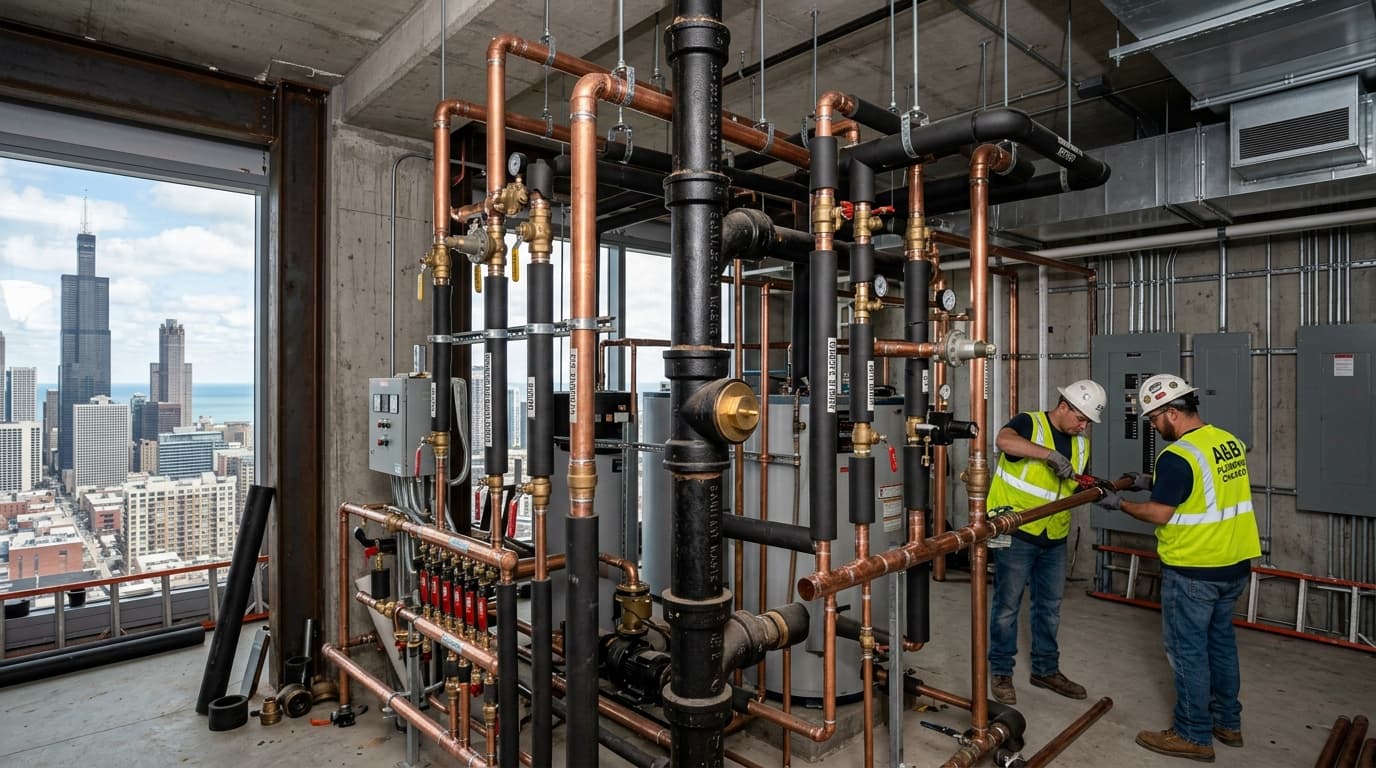
Images illustrate estimating subjects. They do not document our local office, a completed client project or local jobsite experience.
- ICC code adoption information and IAPMO adopted-code information
- Federal wage determination records; confirm any separate state/local requirements with the relevant authority.
- Reconcile civil and building plumbing plans
- Send the jurisdiction and drawings for a scope review
Quick State Facts • Illinois Estimating Baselines
Illinois Plumbing Code (77 Ill. Adm. Code 890) statewide; Chicago Plumbing Code (Title 14B) in Chicago
Illinois Department of Public Health (IDPH) & City of Chicago Department of Buildings
Statewide Illinois Plumber License issued by IDPH (225 ILCS 320); City of Chicago requires separate Chicago plumbing licensing
State IDPH inspection authority across standard municipalities, with independent home-rule building departments in Chicago and major home-rule cities
Frost penetration depths typically range from 36 inches in southern Illinois to 42–48 inches in northern Illinois and the Chicago metropolitan area; depth of bury must be verified against local AHJ codes and project geotechnical reports
Chicago Metropolitan Area (Cook County), DuPage / Will County Commercial & Logistics Hubs, Lake / Kane County Commercial Corridors, Rockford & Northern Illinois, Metro East (St. Louis Metropolitan Border)
Illinois Plumbing Code & Regulatory Environment
Commercial plumbing in Illinois is dual-governed: the Illinois Department of Public Health (IDPH) administers the statewide Illinois Plumbing Code (77 Ill. Adm. Code 890), while the City of Chicago enforces its own home-rule Chicago Plumbing Code (Title 14B of the Municipal Code of Chicago).
State Adoption Structure
The state code is promulgated under statutory authority (225 ILCS 320/); municipalities with populations over 500,000 (Chicago) have statutory authority to enact independent codes with more stringent standards.
State vs. Local AHJ Authority
Chicago code prohibits plastic DWV (PVC/ABS) in commercial buildings, requiring service-weight or no-hub cast iron. Suburban municipalities enforce the state code, which allows PVC where permitted by building construction type.
Key Statutory Plumbing Requirements:
- State-licensed journeymen plumbers must perform installation on commercial projects (225 ILCS 320).
- Commercial plumbing plan submission to IDPH or local certified municipal inspection departments.
- Backflow prevention certification for all containment RPZ devices per Illinois EPA Title 35 requirements.
- Grease basin sizing strictly calculated per Illinois Code Section 890.510 or MWRD local standards.
Plumbing Estimating & Takeoff Scope Considerations in Illinois
Itemized quantity takeoff protocols for commercial plumbing assemblies governed by Illinois codes.
Type L and Type K hard copper piping with brazed or press-connect fittings, copper risers with expansion loops, commercial pressure reducing stations.
Mandatory cast iron (service weight hub-and-spigot or no-hub) in Chicago; Schedule 40 PVC DWV where allowed downstate and in approved suburban construction.
Heavy cast iron roof drainage leaders, primary controlled-flow roof drains, secondary overflow systems, and civil retention connection.
Schedule 40 black iron gas piping with welded fittings for lines 2-1/2" and larger, threaded malleable iron fittings for smaller distribution.
Commercial water closets with 1.28 GPF flushometers, wall-hung lavatories with electronic sensor faucets, mop basins, emergency eyewash stations.
ASME-rated commercial storage water heaters, multi-tank tankless arrays, circulation loops with balancing valves, and expansion tanks.
Triplex domestic water pressure booster pump packages, duplex submersible sewage ejectors, and high-head stormwater sump pumps.
Heavy-density fiberglass pipe insulation with vapor retarder jackets on chilled and domestic cold lines; preformed insulation on hot lines.
Deep trench excavation (48" cover in northern IL), sand or gravel bedding, ductile iron or extra-heavy cast iron under building slab.
Regional Construction Conditions & Site Geotechnical Factors
Regional factors to confirm against the project geotechnical report, engineered details, and permit requirements.
Northern Illinois and Chicago require 42 to 48 inches of cover for exterior water piping to protect against severe winter freeze cycles. Southern Illinois typically requires 36 inches.
Dense glacial till and heavy silty clays throughout Cook, DuPage, and Will counties require stable pipe bedding and stone backfill.
Lakefront construction and projects in the Des Plaines and Illinois river valleys encounter shallow groundwater tables requiring continuous well-point pumping and sheet piling.
Southern Illinois borders the New Madrid Seismic Zone, requiring ASCE 7 seismic sway bracing calculations on commercial piping in Seismic Design Categories C and D.
Dense urban street access in Chicago requires strict off-hours delivery scheduling, street permits, and hoist rigging allowances.
Local Jurisdiction & Project Coverage Matrix
Commercial takeoff considerations across Illinois's key economic centers, county seats, and metropolitan AHJs.
| Area / Market | Primary AHJ or Authority | Local Code / Amendment | Utility Considerations | Major Project Types | Estimating Considerations | Verification Source |
|---|---|---|---|---|---|---|
| City of Chicago (Cook County) | City of Chicago Department of Buildings (DOB) | Chicago Plumbing Code (Title 14B) & Municipal Code Title 14P | Chicago Department of Water Management (DWM) sewer and water main connections | High-rise commercial towers, hospitals, urban multi-family residential | Mandatory cast iron DWV (no PVC); strict copper water requirements; triple-basin garage drainage; UA Local 130 union rates | City of Chicago Department of Buildings |
| Cook County (Suburban Municipalities) | Local Municipal AHJs & IDPH Division of Environmental Health | Illinois Plumbing Code (77 Ill. Adm. Code 890) | Metropolitan Water Reclamation District of Greater Chicago (MWRD) industrial permits | Commercial shopping centers, corporate offices, medical outpatient centers | MWRD interceptor review; 48-inch frost depth excavation; RPZ backflow certifications | IDPH Plumbing Program / MWRD Ordinance |
| DuPage County (Naperville / Wheaton / Oak Brook) | DuPage County Building & Zoning / Municipal Building AHJs | Illinois Plumbing Code (Part 890) | DuPage Water Commission Lake Michigan water distribution | Corporate headquarters, data centers, regional shopping centers | Heavy glacial till trenching; redundant dual-service water lines; deep stormwater detention tie-ins | DuPage County Building & Zoning |
| Will County (Joliet / Bolingbrook / Plainfield) | Will County Land Use Department / Municipal Building Departments | Illinois Plumbing Code (Part 890) | City of Joliet Public Utilities / Local sanitary districts | Mega-warehouse logistics centers, intermodal freight facilities, commercial logistics | Siphonic roof drainage conductors; high-volume oil/water interceptors; bedrock trenching allowances | Will County Land Use / City of Joliet Utilities |
| Lake County (Waukegan / Highland Park) | Lake County Planning, Building and Development / Municipal AHJs | Illinois Plumbing Code (Part 890) | Lake County Public Works water and sewer districts | Pharmaceutical manufacturing cleanrooms, healthcare centers, commercial hospitality | High water table near Lake Michigan; 48-inch water line burial; sub-zero pipe insulation | Lake County Building Division |
Labor Environment & Prevailing Wage Considerations
How commercial mechanical contractors model labor productivity and regulatory wage determinations in Illinois.
Illinois strictly enforces the Illinois Prevailing Wage Act (820 ILCS 130/), requiring prevailing hourly wages and fringe benefits on all public works projects.
Prevailing wage rates are determined and published monthly by the Illinois Department of Labor (IDOL) for every county, categorized by trade (Plumbers, Pipefitters).
Federally funded and federally assisted construction is subject to federal Davis-Bacon wage determination schedules.
The Chicago metropolitan area is predominantly unionized (UA Local 130 Plumbers, UA Local 597 Pipefitters). Open-shop contractors operate primarily on private commercial builds in downstate and outer suburban areas.
Estimates in downtown Chicago require productivity deductions for elevator travel, tight mechanical chase access, urban traffic logistics, and rigid union trade jurisdictional rules.
State-Specific Plumbing Estimating Workflow in Illinois
The 9-step preconstruction process mechanical estimators follow to produce audit-ready bid deliverables.
Review complete architectural drawings, plumbing floor plans, riser schematics, and civil utility drawings.
Determine whether the project is located within the City of Chicago (Title 14B) or suburban/downstate Illinois (IDPH Part 890).
Enforce Chicago cast iron DWV mandates where applicable; verify approved piping specs (copper, cast iron, PVC).
Establish clear takeoff cutoffs at 5 feet outside the building envelope and verify municipal meter pit requirements.
Calculate excavation, trench box shoring, and crushed stone bedding volumes for 42-to-48-inch burial depths.
Apply IDOL prevailing wage schedules for public works or appropriate open-shop/collective bargaining rates for private work.
Obtain current local supply house pricing for piping and quote major mechanical packages (booster pumps, water heaters).
Document trade boundaries (e.g. electrical hookups, final gas utility meter, structural steel framing for carriers).
Compile itemized Bill of Materials, labor hour summaries, and subcontractor proposal letters for general contractor submission.
Frequently Asked Questions • Illinois Plumbing Estimating
Q:What plumbing code is used in Illinois for commercial projects?
Commercial projects in Illinois follow the Illinois Plumbing Code (77 Ill. Adm. Code 890) administered by IDPH, except within the City of Chicago, which enforces the independent Chicago Plumbing Code (Title 14B).
Q:Is PVC pipe permitted for commercial drainage in Chicago?
No. The City of Chicago Plumbing Code prohibits plastic PVC for drain, waste, and vent systems in commercial and multi-family structures, mandating service-weight or no-hub cast iron.
Q:What is the required frost depth in Illinois for plumbing estimating?
Exterior water supply piping requires minimum burial of 42 to 48 inches in northern Illinois and Chicago, and approximately 36 inches in southern Illinois, subject to local AHJ verification.
Q:Who licenses commercial plumbers in Illinois?
The Illinois Department of Public Health (IDPH) licenses plumbers statewide under the Illinois Plumbing License Law. The City of Chicago administers its own plumbing license examinations and registrations.
Q:Are prevailing wages mandatory on public works in Illinois?
Yes. Under the Illinois Prevailing Wage Act (820 ILCS 130/), all public works construction funded in whole or part by public funds must pay prevailing wage rates established by the Illinois Department of Labor.
Request a Detailed Plumbing Estimate in Illinois
Submit your drawing set and specifications. We review civil utility tie-ins, riser isometric diagrams, and local AHJ codes to provide an itemized Bill of Materials and MCAA labor estimate on the agreed schedule.
Bidding Commercial Work in Illinois?
We prepare complete CSI Division 22 takeoff packages formatted for quick review and direct bid day submission.
Instant Quote Calculator
Estimate your Illinois project turnaround and pricing.
Share your scope and bid deadline. Pricing and delivery dates are confirmed after drawing review.