Plumbing Estimating Services in Kansas
Remote plumbing takeoffs and cost estimating for projects in Kansas. Share the project jurisdiction, current drawings, specifications, and bid deadline to confirm scope and delivery. This service-area page does not represent a local office.
What do commercial plumbing estimating services in Kansas involve?
Commercial plumbing estimating services in Kansas provide digital quantity takeoffs, fixture schedules, and CSI Division 22 bid packages. Because Kansas operates under Home Rule with no mandatory statewide plumbing code, estimators verify municipal adoptions (predominantly 2018 or 2021 IPC with local amendments) across Johnson County, Wichita, and Topeka. Takeoffs require civil utility plans, architectural floor plans, riser schematics, and mechanical specifications.
Kansas Takeoff Scope Verification Checklist
Confirm the project jurisdiction in Kansas
Remote estimating starts with the project address and issued documents. A service-area name does not determine the permit authority, utility requirements, wage basis or actual site conditions.
For the areas discussed here, including Johnson County, Sedgwick County, Wyandotte County, identify the authority and utility serving the actual parcel rather than applying a statewide assumption.
- Share the permit cover sheet or designer’s code summary, adopted edition and local amendment references.
- Provide utility connection details, meter/backflow selections and the civil-to-building package handoff.
- Use project geotechnical and engineered details for burial, excavation, soil protection and restraint quantities.
- Identify public/private funding and the applicable wage determination before supplying labor rates.
Regional code, soil and wage descriptions on this page require project-specific verification. They are not a permit approval, site survey or published local labor quotation.
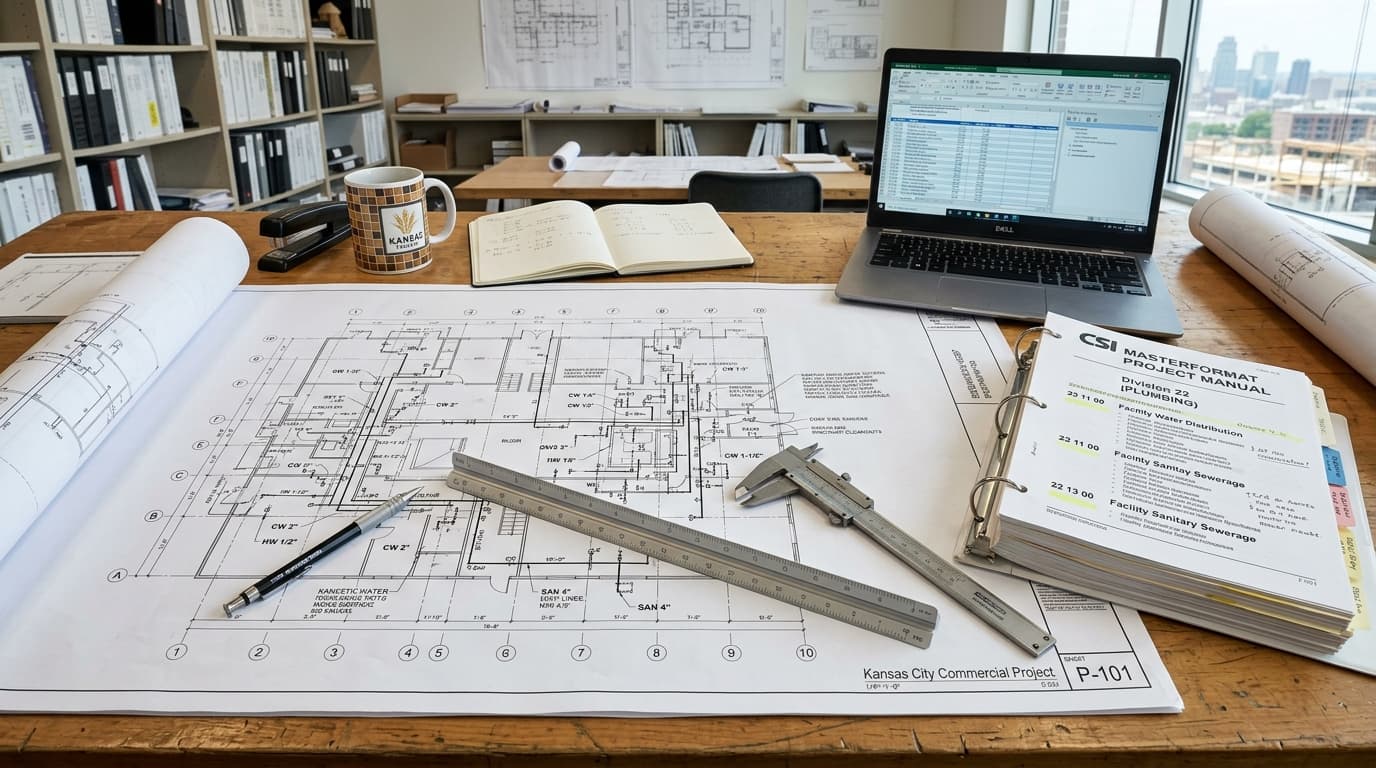
Images illustrate estimating subjects. They do not document our local office, a completed client project or local jobsite experience.
- ICC code adoption information and IAPMO adopted-code information
- Federal wage determination records; confirm any separate state/local requirements with the relevant authority.
- Reconcile civil and building plumbing plans
- Send the jurisdiction and drawings for a scope review
Quick State Facts • Kansas Estimating Baselines
2018 / 2021 International Plumbing Code (IPC) with municipal amendments
Local Municipalities and County Commissions under Kansas Home Rule Authority
Municipal and county-level licensing; standard testing via Prometric or ICC examinations; no single statewide license
Home-rule municipal building departments and county joint agencies (e.g., Wichita/Sedgwick County MABCD)
Regional frost line depth typically ranges from 30 inches in southern Kansas to 36 inches in northern and eastern Kansas; final depths must be verified against local AHJ codes and project geotechnical reports
Kansas City Metro (Johnson & Wyandotte Counties), Wichita Metropolitan Area (Sedgwick County), Topeka Capital Corridor (Shawnee County), Lawrence University Hub (Douglas County)
Kansas Plumbing Code & Regulatory Environment
Kansas does not mandate a universal, statewide commercial plumbing code. Under Article 12, Section 5 of the Kansas Constitution and Kansas Statutes Annotated (K.S.A. 12-101 et seq. and K.S.A. 19-101a), municipalities and counties exercise Home Rule authority to adopt and enforce building codes independently.
State Adoption Structure
Individual cities and counties adopt editions of the International Plumbing Code (IPC)—most commonly the 2018 or 2021 editions—incorporating local amendments addressing regional utility requirements and soil considerations.
State vs. Local AHJ Authority
Because regulatory power is strictly municipal or county-based, preconstruction estimators must never assume uniform requirements across city boundaries within the same metropolitan area.
Key Statutory Plumbing Requirements:
- Local municipal permit acquisition and contractor licensing verification prior to bid submission.
- Backflow prevention containment assemblies conforming to local water purveyor cross-connection control rules.
- Commercial grease interceptor sizing calibrated to municipal wastewater discharge pretreatment standards.
- Storm drainage conductor calculations aligned with local rainfall rate intensity data (typically 5.0 to 6.0 inches per hour for 100-year storm events).
Plumbing Estimating & Takeoff Scope Considerations in Kansas
Itemized quantity takeoff protocols for commercial plumbing assemblies governed by Kansas codes.
Linear footages of Type L hard-drawn copper piping, Viega ProPress fittings, PEX distribution loops for multi-family builds, and commercial PRV stations.
Schedule 40 PVC DWV in standard commercial occupancies; service-weight or no-hub cast iron soil pipe in return-air plenums, healthcare, and high-density acoustic assemblies.
Primary roof drains with internal flow control, secondary overflow conductors discharging to daylight or scuppers, and underground SDR-35 / PVC storm collection.
Schedule 40 black steel piping with threaded or welded fittings, corrugated stainless steel tubing (CSST) for terminal runs, and low-to-medium pressure regulator stations.
Commercial water closets, ADA flush valves, wall-hung lavatories, service sinks, electric water coolers, and eyewash stations.
Commercial gas-fired power-vent water heaters, tankless manifold racks, thermal expansion tanks, and recirculating pumps.
Domestic water booster packages for multi-story buildings, submersible sanitary sewage ejectors, and groundwater sump pumps.
Fiberglass pipe insulation with ASJ vapor barriers on domestic cold water to prevent condensation, and hot water lines for energy conservation.
Trench excavation, laser-leveled granular bedding (crushed stone or sand), underground sanitary pipe laying, and compacted backfill volume.
Regional Construction Conditions & Site Geotechnical Factors
Regional factors to confirm against the project geotechnical report, engineered details, and permit requirements.
Regional freeze penetration averages 30 inches in southern Kansas to 36 inches in northern and eastern Kansas. All exterior water service piping must maintain verified depth of bury or engineered heat trace insulation.
Eastern Kansas (Kansas City, Topeka, Lawrence) is dominated by expansive smectite/montmorillonite clay formations. Underground slab-on-grade piping requires void boxes, flexible couplings, and crushed stone bedding to absorb shrink-swell cycles without shearing.
River bottomlands adjacent to the Kansas and Missouri rivers present elevated water tables during spring runoff, requiring trench box shoring and temporary sump dewatering allowances.
Kansas falls within low-to-moderate seismic risk zones (IBC Seismic Design Category A and B), minimizing rigid seismic sway bracing costs unless specified for critical facilities. Soil resistivity in clay zones mandates dielectric isolation unions.
Metropolitan Kansas City and Wichita offer extensive plumbing supply house networks, while western rural projects require logistical freight allowances and material staging coordination.
Local Jurisdiction & Project Coverage Matrix
Commercial takeoff considerations across Kansas's key economic centers, county seats, and metropolitan AHJs.
| Area / Market | Primary AHJ or Authority | Local Code / Amendment | Utility Considerations | Major Project Types | Estimating Considerations | Verification Source |
|---|---|---|---|---|---|---|
| Johnson County (Overland Park / Olathe / Shawnee) | Johnson County Building Codes & Municipal Building Departments | 2021 IPC with Johnson County Amendments | WaterOne backflow containment rules; Johnson County Wastewater (JCW) grease interceptor requirements | Corporate office campuses, healthcare centers, multi-family mid-rises | Expansive clay trench bedding; mandatory backflow test cocks; acoustic cast iron in multi-family | Johnson County Contractor Licensing / WaterOne Standards |
| Sedgwick County (Wichita Metroplex) | Metropolitan Area Building and Construction Department (MABCD) | 2021 IPC with Wichita/Sedgwick County MABCD Amendments | City of Wichita Public Works & Utilities water tie-ins and sewer capacity fees | Aerospace manufacturing facilities, commercial distribution, medical facilities | Sandy loam bedding; MABCD-specific cleanout spacing and storm roof drain overflow sizing | MABCD Unified Building & Plumbing Code |
| Wyandotte County (Kansas City, KS) | Unified Government of Wyandotte County / KCK Building Inspection | 2018 / 2021 IPC with Unified Government Amendments | Kansas City Board of Public Utilities (BPU) electric and water connections | Industrial logistics warehouses, intermodal rail facilities, food processing plants | Combined sewer overflow separation; heavy industrial oil/water and grease separators | UG Building Inspection Division / BPU Rules |
| Shawnee County (Topeka Capital Area) | City of Topeka Development Services Department | 2018 IPC with City of Topeka Revisions | City of Topeka Utilities Department water meter pits and service connections | State government institutional complexes, healthcare hospitals, higher education | Domestic water pressure booster stations; 36-inch frost burial depth verification | City of Topeka Development Services |
| Douglas County (Lawrence Metro) | City of Lawrence Planning & Development Services | 2021 IPC with City of Lawrence Amendments | City of Lawrence Municipal Utilities cross-connection control | University student housing, research laboratories, mixed-use commercial | Acid-resistant lab waste piping; strict multi-family acoustic cast iron requirements | City of Lawrence Planning & Development |
Labor Environment & Prevailing Wage Considerations
How commercial mechanical contractors model labor productivity and regulatory wage determinations in Kansas.
Kansas repealed its state prevailing wage statute in 1987. State-funded and local public works projects do not require state prevailing wages unless explicitly adopted by the local contracting municipality.
Private commercial and general public works projects operate largely under open-shop market competitive wages, while municipal entities like Unified Government may enforce project-specific wage standards.
Federal projects (military bases such as Fort Leavenworth and McConnell AFB, VA hospitals, federally assisted highway/housing infrastructure) require full compliance with U.S. Department of Labor Davis-Bacon wage determinations.
United Association (UA) Local 8 (Greater Kansas City) and UA Local 441 (Statewide Kansas) maintain active representation on major healthcare, industrial manufacturing, and institutional projects, while suburban and commercial retail projects reflect strong open-shop participation.
Preconstruction labor estimates must reflect regional trade availability, winter temperature productivity reductions for slab trenching, and project-specific crane/rigging requirements for rooftop mechanical units.
State-Specific Plumbing Estimating Workflow in Kansas
The 9-step preconstruction process mechanical estimators follow to produce audit-ready bid deliverables.
Examine architectural floor plans, civil utility site drawings, mechanical plumbing schedules, and geotechnical soil boring logs.
Review material schedules to verify approved piping materials (copper vs PEX, PVC vs cast iron), valve standards, and fixture models.
Review all issued addenda and alternate pricing items prior to quantifying takeoff runs to ensure scope completeness.
Confirm municipal code edition (e.g., 2018 vs 2021 IPC) and identify local municipal amendments with the relevant jurisdiction.
Verify water purveyor requirements for meter vault location, backflow containment type, and municipal connection details.
Select appropriate labor rate structures (open-shop commercial rates vs Davis-Bacon determinations) and adjust MCAA hours for site conditions.
Obtain current pricing from regional supply houses for pipe, valves, fittings, and quote major equipment (water heaters, booster pumps).
Formulate clear qualification letters outlining exact scope boundaries (e.g. site utility demarcation 5 feet outside building foundation).
Perform subcontractor bid leveling, verify overhead and profit markups, and prepare turnkey proposal packages for general contractor tender.
Frequently Asked Questions • Kansas Plumbing Estimating
Q:What plumbing code is used in Kansas for commercial estimating?
Kansas does not mandate a single statewide code; instead, local jurisdictions adopt codes independently. The vast majority of municipalities—including Johnson County, Wichita (MABCD), and Kansas City (UG)—enforce the 2018 or 2021 International Plumbing Code (IPC) with local amendments.
Q:Who regulates plumbing contractor licensing in Kansas?
Plumbing contractor licensing in Kansas is governed at the county or municipal level rather than by a state board. Major programs include the Johnson County Contractor Licensing Program and the Wichita/Sedgwick County Metropolitan Area Building and Construction Department (MABCD).
Q:How does regional frost depth affect Kansas plumbing takeoffs?
Frost depth requirements typically range from 30 inches in southern Kansas to 36 inches in northern/eastern Kansas. Takeoffs must incorporate excavation, granular bedding, and compacted backfill down to the verified AHJ depth.
Q:What documents are required for a commercial plumbing takeoff in Kansas?
Estimators require architectural floor plans, civil site utility plans, plumbing fixture schedules, riser isometric diagrams, structural foundation drawings, and Division 22 written project specifications.
Q:Are prevailing wages required on commercial plumbing projects in Kansas?
Kansas does not have a state prevailing wage law for state or local projects. However, federal projects are governed by U.S. Department of Labor Davis-Bacon wage determinations, and private projects operate under commercial open-shop or collective bargaining rates.
Request a Detailed Plumbing Estimate in Kansas
Submit your drawing set and specifications. We review civil utility tie-ins, riser isometric diagrams, and local AHJ codes to provide an itemized Bill of Materials and MCAA labor estimate on the agreed schedule.
Bidding Commercial Work in Kansas?
We prepare complete CSI Division 22 takeoff packages formatted for quick review and direct bid day submission.
Instant Quote Calculator
Estimate your Kansas project turnaround and pricing.
Share your scope and bid deadline. Pricing and delivery dates are confirmed after drawing review.