Plumbing Estimating Services in Ohio
Remote plumbing takeoffs and cost estimating for projects in Ohio. Share the project jurisdiction, current drawings, specifications, and bid deadline to confirm scope and delivery. This service-area page does not represent a local office.
What do commercial plumbing estimating services in Ohio involve?
Commercial plumbing estimating services in Ohio deliver CSI Division 22 material takeoffs, MCAA labor productivity analysis, and subcontractor tender preparation. Estimating aligns with the Ohio Plumbing Code (OAC 4101:3 based on the 2021 IPC) and Ohio Board of Building Standards regulations. Projects require architectural plans, MEP drawings, utility service profiles, and local municipal health district requirements.
Ohio Takeoff Scope Verification Checklist
Confirm the project jurisdiction in Ohio
Remote estimating starts with the project address and issued documents. A service-area name does not determine the permit authority, utility requirements, wage basis or actual site conditions.
For the areas discussed here, including Franklin County, Cuyahoga County, Hamilton County, identify the authority and utility serving the actual parcel rather than applying a statewide assumption.
- Share the permit cover sheet or designer’s code summary, adopted edition and local amendment references.
- Provide utility connection details, meter/backflow selections and the civil-to-building package handoff.
- Use project geotechnical and engineered details for burial, excavation, soil protection and restraint quantities.
- Identify public/private funding and the applicable wage determination before supplying labor rates.
Regional code, soil and wage descriptions on this page require project-specific verification. They are not a permit approval, site survey or published local labor quotation.
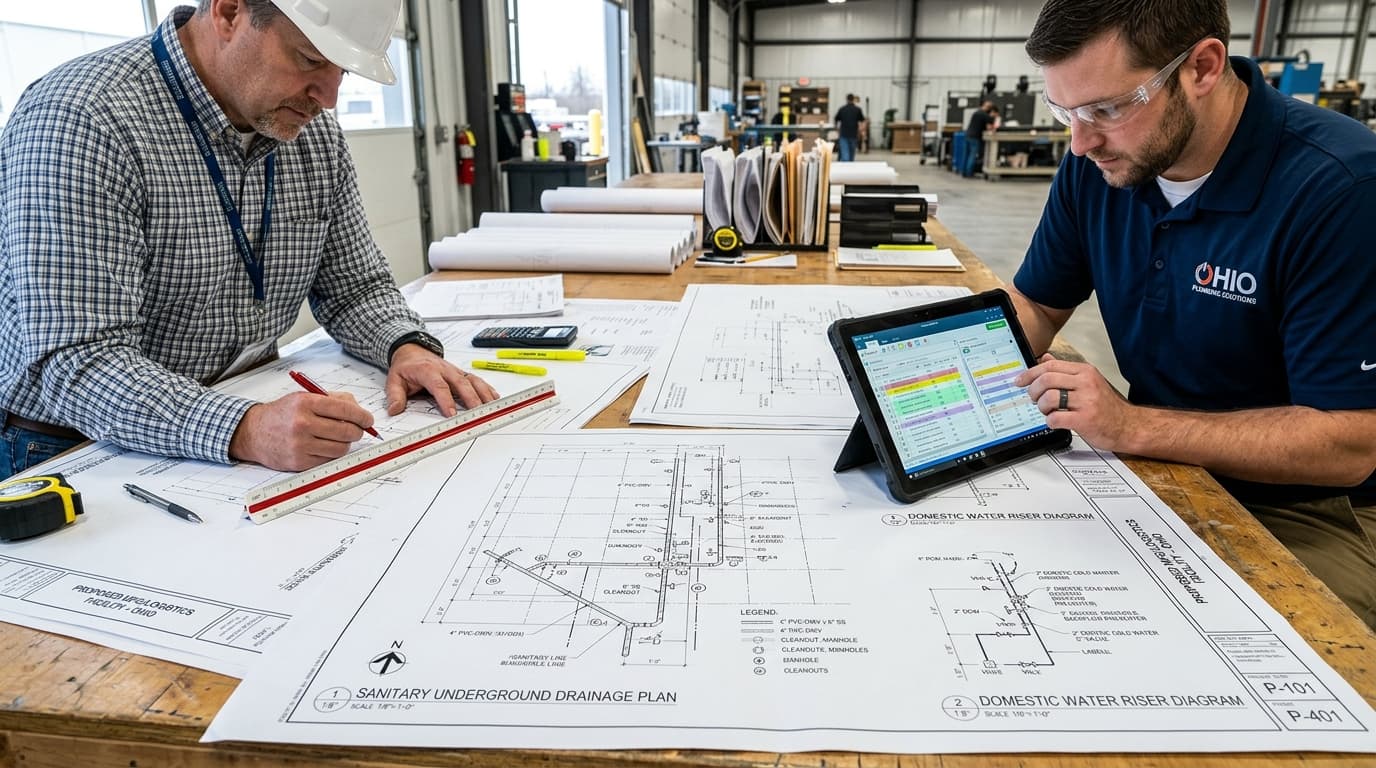
Images illustrate estimating subjects. They do not document our local office, a completed client project or local jobsite experience.
- ICC code adoption information and IAPMO adopted-code information
- Federal wage determination records; confirm any separate state/local requirements with the relevant authority.
- Reconcile civil and building plumbing plans
- Send the jurisdiction and drawings for a scope review
Quick State Facts • Ohio Estimating Baselines
Ohio Plumbing Code (OAC Chapter 4101:3) based on the 2021 International Plumbing Code (IPC)
Ohio Board of Building Standards (BBS), Ohio Department of Commerce
Statewide commercial plumbing contractor license issued by OCILB under ORC Chapter 4740; journeyman and apprentice regulations managed locally or via registered programs
Certified municipal and county building departments; uncertified jurisdictions default to the Ohio Division of Industrial Compliance
Regional frost depths typically range from 32 inches along the Ohio River to 36–42 inches in central and northern Ohio (Lake Erie snowbelt); subject to local code and site verification
Columbus Metropolitan Area (Franklin County), Greater Cleveland (Cuyahoga County), Greater Cincinnati (Hamilton County), Dayton Metroplex (Montgomery County), Akron-Canton Industrial Corridor
Ohio Plumbing Code & Regulatory Environment
Commercial plumbing in Ohio is regulated statewide under the Ohio Plumbing Code (OPC), codified in Ohio Administrative Code (OAC) Chapter 4101:3, adopted by the Ohio Board of Building Standards (BBS).
State Adoption Structure
The Ohio Plumbing Code incorporates the model International Plumbing Code (2021 edition) with state-specific amendments adopted under Ohio Revised Code Chapter 3781.
State vs. Local AHJ Authority
The state code applies uniformly to all commercial buildings across Ohio. Local certified building departments administer plan reviews and inspections, but cannot enact amendments that conflict with the statewide BBS code.
Key Statutory Plumbing Requirements:
- Commercial contractors must maintain an active OCILB license (ORC 4740) and state-approved liability insurance.
- Commercial plan approval required from local certified building departments or Ohio Division of Industrial Compliance.
- Backflow prevention assemblies must comply with Ohio EPA and local water purveyor regulations.
- Separation of combined sewer discharges conforming to local environmental requirements (MSDGC, NEORSD).
Plumbing Estimating & Takeoff Scope Considerations in Ohio
Itemized quantity takeoff protocols for commercial plumbing assemblies governed by Ohio codes.
Type L copper tubing with ProPress or soldered joints, PEX-a riser loops in multi-family projects, PRV stations, and lead-free commercial ball valves.
Schedule 40 PVC DWV in standard commercial construction; cast iron hubless piping for acoustical performance and return-air plenums.
Interior vertical rainwater conductors, primary and overflow roof drains, and heavy-duty storm sewer connections.
Schedule 40 black iron gas piping, welded joints on 2-1/2" and larger, corrugated stainless steel tubing (CSST) for appliance drops.
Commercial vitreous china water closets, high-efficiency urinals, ADA lavatories with sensor faucets, service sinks, and emergency shower units.
High-efficiency condensing gas commercial water heaters, tankless manifold arrays, expansion tanks, and recirculation circulators.
Duplex domestic water booster pump packages, submersible sanitary sump/ejector systems, and elevator pit sump pumps with oil alarms.
Fiberglass pipe insulation with all-service vapor-retarder jackets on cold water lines; thermal insulation on hot water and return lines.
Trench excavation (36" to 42" cover), No. 57 crushed stone bedding, laser-graded underground pipe installation, and backfill.
Regional Construction Conditions & Site Geotechnical Factors
Regional factors to confirm against the project geotechnical report, engineered details, and permit requirements.
Northern Ohio near Lake Erie requires up to 42 inches of burial cover to protect water service mains from lake-effect deep freezing. Central and southern Ohio require 32 to 36 inches.
Dense glacial till and heavy clay across central Ohio require aggregate trench bedding. Eastern Ohio features shale and sandstone bedrock requiring rock-hammering contingencies.
Sites along the Lake Erie shoreline, Ohio River valley, and Scioto River bottomlands require trench shoring and temporary dewatering allowances.
Ohio is classified in low-to-moderate seismic categories (IBC Seismic Design Category A and B), with minimal special bracing requirements. Heavy clay soils require polywrap or dielectric protection on buried ductile iron lines.
Major metropolitan areas (Columbus, Cleveland, Cincinnati) feature comprehensive supply networks; rural Appalachian counties require additional freight and delivery lead-time buffers.
Local Jurisdiction & Project Coverage Matrix
Commercial takeoff considerations across Ohio's key economic centers, county seats, and metropolitan AHJs.
| Area / Market | Primary AHJ or Authority | Local Code / Amendment | Utility Considerations | Major Project Types | Estimating Considerations | Verification Source |
|---|---|---|---|---|---|---|
| Franklin County (Columbus Metro / Dublin) | City of Columbus Building & Zoning Services / Franklin County | Ohio Plumbing Code (OAC 4101:3) | City of Columbus Division of Water & Division of Sewerage and Drainage | Data centers, commercial tech campuses, multi-family mid-rises | High-capacity cooling loop takeoffs; fast-track tenant fit-outs; 36-inch frost burial | City of Columbus Building & Zoning / Ohio BBS |
| Cuyahoga County (Cleveland / Lakewood) | City of Cleveland Department of Building and Housing / Municipal AHJs | Ohio Plumbing Code with Cleveland Rules | Northeast Ohio Regional Sewer District (NEORSD) stormwater fees | Healthcare complexes (Cleveland Clinic), industrial manufacturing, urban high-rises | 42-inch Lake Erie frost depth; heavy cast iron retrofits; stormwater detention compliance | City of Cleveland Building & Housing / NEORSD |
| Hamilton County (Cincinnati Metro) | City of Cincinnati Buildings and Inspections / Hamilton County AHJs | Ohio Plumbing Code | Metropolitan Sewer District of Greater Cincinnati (MSDGC) | Corporate headquarters, university healthcare research, commercial distribution | MSDGC combined sewer separation; karst limestone rock excavation; backwater valve assemblies | MSDGC / City of Cincinnati Buildings & Inspections |
| Montgomery County (Dayton Metro) | Montgomery County Building Regulations Department | Ohio Plumbing Code | City of Dayton Water Department / Wellfield Protection Area | Aerospace research, defense manufacturing, logistics centers | Strict wellfield protection secondary containment; backflow assemblies; sand/gravel bedding | Montgomery County Building Regulations |
| Summit County (Akron / Cuyahoga Falls) | Summit County Department of Building Standards | Ohio Plumbing Code | City of Akron Public Utilities Bureau | Polymer research laboratories, commercial warehousing, hospital facilities | Industrial chemical waste piping; acid neutralization tanks; glacial gravel/clay trenching | Summit County Department of Building Standards |
Labor Environment & Prevailing Wage Considerations
How commercial mechanical contractors model labor productivity and regulatory wage determinations in Ohio.
Ohio Prevailing Wage Law (Ohio Revised Code Chapter 4115) governs public improvement projects funded by the state or political subdivisions.
Prevailing wage applies only when project total costs exceed statutory monetary thresholds established biennially by the Ohio Department of Commerce.
Federal government construction projects (Wright-Patterson AFB, NASA Glenn, VA hospitals) require compliance with federal Davis-Bacon wage determinations.
Major urban commercial centers feature strong union presence (UA Local 189 Columbus, UA Local 55 Cleveland, UA Local 392 Cincinnati), while suburban commercial and rural projects operate in a competitive open-shop environment.
Labor hours should be calculated using baseline MCAA units adjusted for site accessibility, winter weather conditions in northern Ohio, and multi-story riser logistics.
State-Specific Plumbing Estimating Workflow in Ohio
The 9-step preconstruction process mechanical estimators follow to produce audit-ready bid deliverables.
Examine architectural floor plans, civil site drawings, and Division 22 plumbing specifications.
Confirm compliance with the Ohio Plumbing Code (OAC 4101:3) and verify local sewer authority rules (NEORSD, MSDGC).
Take off all commercial plumbing fixtures, carrier assemblies, water heaters, and pumping systems.
Digitally measure domestic water, sanitary DWV, storm, and gas lines, categorizing by pipe size and material.
Calculate excavation trenching, shoring, and granular stone bedding based on verified regional frost depth (32" to 42").
Determine whether Ohio Prevailing Wage, Davis-Bacon, or open-shop wage rates apply, adjusting MCAA hours accordingly.
Solicit current vendor pricing from local Ohio plumbing supply houses for pipe, fittings, and equipment packages.
Clearly delineate scope boundaries (e.g. 5 feet outside building wall for site utility demarcation).
Assemble itemized Bill of Materials, subcontractor scope letters, and final bid summaries for GC tender.
Frequently Asked Questions • Ohio Plumbing Estimating
Q:What plumbing code is enforced in Ohio for commercial estimating?
Commercial plumbing in Ohio is regulated statewide by the Ohio Plumbing Code (OAC Chapter 4101:3), which adopts the 2021 International Plumbing Code (IPC) with state-specific amendments.
Q:Who regulates commercial plumbing contractors in Ohio?
Commercial plumbing contractors in Ohio are licensed statewide by the Ohio Construction Industry Licensing Board (OCILB), an agency of the Ohio Department of Commerce, under Ohio Revised Code Chapter 4740.
Q:What is the standard frost depth for plumbing takeoffs in Ohio?
Frost depth ranges from 32 inches in southern Ohio along the Ohio River to 36–42 inches in central and northern Ohio (Lake Erie shoreline). Depth of bury must be verified with the local building department.
Q:Does Ohio require prevailing wage on commercial plumbing jobs?
Ohio Prevailing Wage Law (ORC 4115) applies to public improvement projects funded by public authorities that exceed statutory threshold amounts. Private commercial construction is exempt.
Q:What drawings are needed for an accurate Ohio commercial plumbing takeoff?
Estimators require architectural floor plans, civil site utility drawings, plumbing fixture schedules, riser isometric diagrams, and mechanical Division 22 project specifications.
Request a Detailed Plumbing Estimate in Ohio
Submit your drawing set and specifications. We review civil utility tie-ins, riser isometric diagrams, and local AHJ codes to provide an itemized Bill of Materials and MCAA labor estimate on the agreed schedule.
Bidding Commercial Work in Ohio?
We prepare complete CSI Division 22 takeoff packages formatted for quick review and direct bid day submission.
Instant Quote Calculator
Estimate your Ohio project turnaround and pricing.
Share your scope and bid deadline. Pricing and delivery dates are confirmed after drawing review.