What plumbing estimating services are available in Orange, who uses them, and what project documents are needed?
Commercial plumbing estimating services in Orange provide trade subcontractors, general contractors, and developers with itemized material takeoffs, MCAA labor hours, and competitive bid packages. Estimates account for applicable California Plumbing Code (CPC) standards, local municipal amendments, designated recycled water dual-plumbing zones, and developer tenant criteria. Preconstruction bids are compiled from architectural, civil, mechanical, and plumbing blueprint sets.
Confirm the project jurisdiction in Orange
Remote estimating starts with the project address and issued documents. A service-area name does not determine the permit authority, utility requirements, wage basis or actual site conditions.
- Share the permit cover sheet or designer’s code summary, adopted edition and local amendment references.
- Provide utility connection details, meter/backflow selections and the civil-to-building package handoff.
- Use project geotechnical and engineered details for burial, excavation, soil protection and restraint quantities.
- Identify public/private funding and the applicable wage determination before supplying labor rates.
Regional code, soil and wage descriptions on this page require project-specific verification. They are not a permit approval, site survey or published local labor quotation.
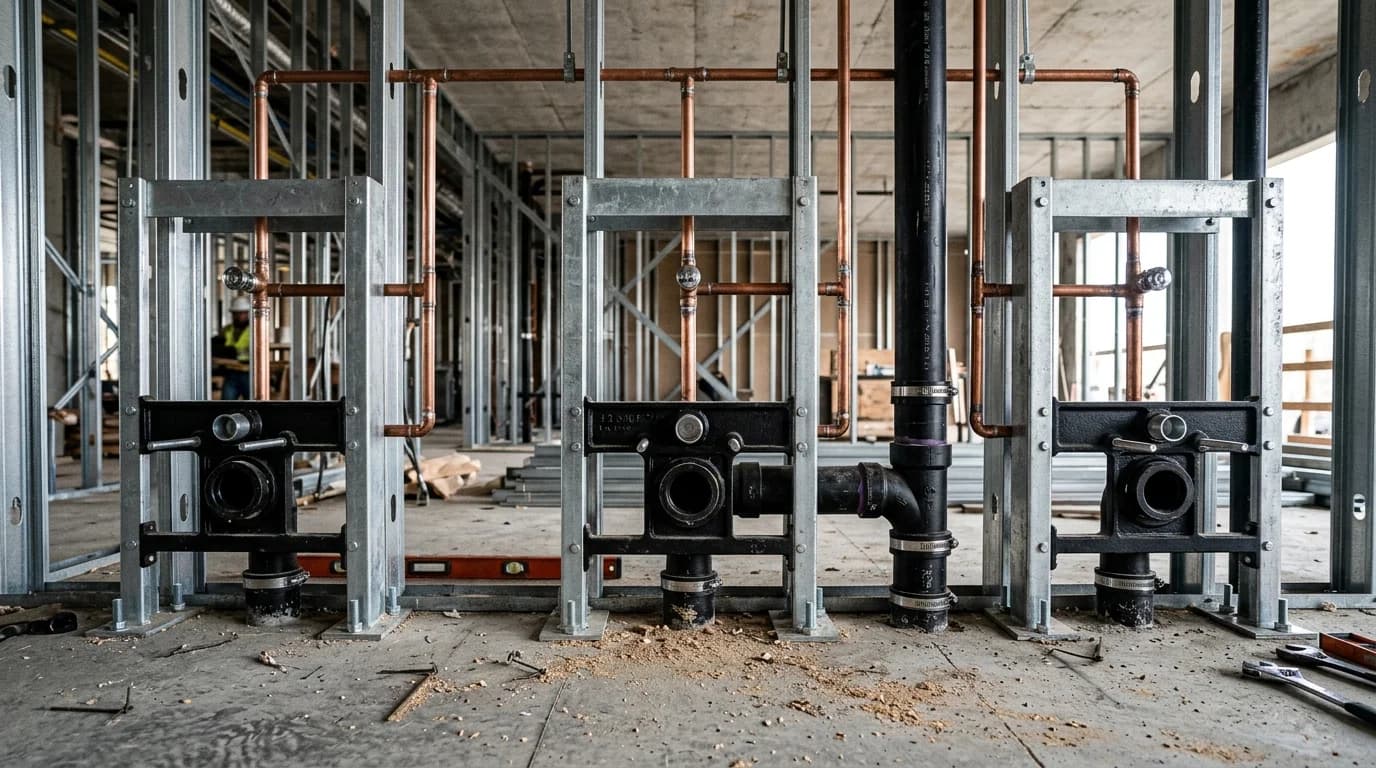
Images illustrate estimating subjects. They do not document our local office, a completed client project or local jobsite experience.
- ICC code adoption information and IAPMO adopted-code information
- Federal wage determination records; confirm any separate state/local requirements with the relevant authority.
- Reconcile civil and building plumbing plans
- Send the jurisdiction and drawings for a scope review
Plumbing Estimating Services in Orange
Commercial construction across Orange requires balancing statewide water efficiency standards with localized tenant improvement requirements and utility service boundaries. Our estimating team provides audit-ready preconstruction support:
Commercial & TI Quantity Takeoffs
Itemized linear footage and fitting counts for domestic cold water, hot water, recirculating loops, sanitary waste, and natural gas systems.
Designated Recycled Water Takeoffs
Accurate quantification of Title 22 purple pipe dual-distribution loops, air-gap backflow devices, and cross-connection test ports where required.
MCAA Labor Unit Application
Calibrated journeyman installation hours adjusted for occupied building retrofits, tight ceiling plenum spaces, and regional Southern California labor productivity.
Tenant Criteria & Scope Reconciliation
Comprehensive alignment with commercial landlord standards (e.g. Irvine Company base-building rules), eliminating unbudgeted material exclusions.
Orange Construction & Estimating Context
The local construction market spans master-planned business campuses, world-class resort hospitality, and coastal retail developments:
Tenant improvement (TI) restroom reconfigurations, copper domestic water branch lines, point-of-use electric water heaters, and Title 24 submetering.
High-capacity commercial kitchens, heavy-duty hydromechanical grease interceptors, central gas-fired boiler systems, and multi-station public restroom fixture batteries.
Marine coastal atmospheric corrosion derating, stainless steel 316 exterior rooftop supports, brass valve body requirements, and flood-mitigation backwater valves.
Repetitive bathroom fixture batteries, acoustic cast iron vertical drops, central domestic hot water circulation loops, and tenant submetering manifolds.
Local Code, AHJ & Utility Considerations
Estimators must distinguish between statewide code baselines, utility district service boundaries, and project-specific developer criteria:
| Requirement Level | Governing Authority & Citation | Scope Impact & Estimating Mandate |
|---|---|---|
| Statewide Code Baseline | California Building Standards Commission (CBSC)applicable California Plumbing Code (Title 24 Part 5) | Check the applicable state rules Establishes baseline fixture flow rates (1.28 GPF commercial toilets, 0.125 GPF urinals), UPC drainage fixture units, and AB 1953 lead-free potable water compliance. |
| County & Municipal Building Administration | Orange County Public Works (OCPW) & City Building DepartmentsOCPW Building Code / Municipal Codes (Anaheim, Irvine, Santa Ana) | Confirm with the local authority Governs building permits, seismic anchor inspections, and local utility tie-ins. Individual cities enforce municipal building amendments and local drainage review. |
| Recycled Water Dual-Plumbing (Designated Zones) | Orange County Water District (OCWD) / Irvine Ranch Water District (IRWD)California Title 22 Division 4 Chapter 3 & IRWD Rules & Regulations | [UTILITY REQUIREMENT] Required ONLY within designated reclaimed water service zones. In approved commercial buildings, mandates separate purple pipe dual-plumbing for toilet flushing and landscape irrigation with physical air-gap backflow isolation. |
| Commercial Master Developer Standards | Commercial Business Parks (e.g., Irvine Company Tenant Criteria)Commercial Lease Agreement Base Building Technical Specifications | Confirm project requirements Master-planned office and retail campuses frequently specify strict submetering, copper Type L domestic water (prohibiting CPVC/PEX in commercial plenums), and grease trap remote monitoring. |
| Geotechnical & Soil Considerations | Project Geotechnical Report / Local Structural Foundation CriteriaExpansive Clay Soil Underslab Penetration Details | Confirm project requirements Projects situated in expansive clay soils require flexible rubber sleeve boots and double-wrapped corrosion-resistant tape on all underslab plumbing penetrations to prevent shear failure. |
What This Means for the Estimate
Local building conditions translate directly into bill of material line items and labor hour adjustments:
- Recycled Water Scope Verification: If a project is located within an IRWD or OCWD reclaimed water zone, estimators must quantify dedicated purple-jacketed pipe runs, distinct brass ball valves, and reduced pressure zone (RPZ) backflow preventers.
- Landlord Base Building Material Standards: Master office parks frequently prohibit PEX or CPVC in commercial ceiling plenums; bids must budget Type L hard-drawn copper with soldered or press fittings.
- Coastal Corrosion Adjustments: Projects within 3 miles of the Pacific coastline require derating exposed exterior hardware and specifying 316 stainless steel struts and coated vent flashings.
- Clay Soil Underslab Penetration Sleeves: Geotechnical criteria in expansive clay zones mandate flexible rubber sleeve boots and double-layer polyethylene wrapping on all underslab plumbing penetrations.
Drawings & Project Documents Required
For a complete commercial or tenant improvement takeoff, we request:
Local Plumbing Estimating Workflow
Common Scope Risks on Orange Bids
Do not assume recycled purple pipe is required everywhere. Verify utility provider service boundaries (e.g. IRWD vs. municipal city water) to avoid carrying unneeded dual-piping scope.
Audit master landlord criteria (e.g. Irvine Company standards) to verify allowable pipe materials; many restrict PEX or CPVC in commercial plenums.
For projects within coastal zones (Newport, Huntington Beach), ensure rooftop natural gas lines and exhaust supports carry required protective coatings.
Confirm whether the plumbing contractor carries exterior backflow assemblies and grease interceptor excavation or if civil carries to 5 feet outside building.
Review geotechnical reports for soil expansiveness; budget flexible penetration sleeves and pipe bedding sand where specified.
Deliverables You Receive
Frequently Asked Questions (FAQs)
Does every commercial project in Orange require recycled water dual-piping?
No. [UTILITY REQUIREMENT] Recycled water dual-piping (purple pipe) is strictly required only on designated properties within specific water district service areas (such as Irvine Ranch Water District [IRWD] reclaimed water zones) where utility infrastructure exists. Estimators must verify project utility availability before budgeting dual distribution loops.
What plumbing codes govern commercial estimating in Orange?
Projects in Orange are governed by the applicable California Plumbing Code (CPC / Title 24 Part 5), along with local municipal amendments adopted by individual cities (such as Anaheim, Irvine, Santa Ana, or Costa Mesa) and CalGreen Title 24 Part 11 commercial water efficiency limits.
What drawings are needed for a commercial tenant improvement (TI) takeoff in Orange?
Commercial TI takeoffs require architectural demo and proposed floor plans, reflected ceiling plans (RCP), plumbing demolition and new work plans, plumbing equipment schedules, and landlord base-building tenant criteria.
How are coastal atmospheric conditions factored into plumbing estimates?
For projects in coastal environments (such as Newport Beach or Huntington Beach), estimators must derate exposed hardware, budgeting stainless steel 316 pipe hangers, brass valve trims, and anti-corrosive protective paint coatings on exposed rooftop gas and vent piping.
How are commercial grease interceptors estimated for resort and hospitality venues?
Hospitality venues require sizing exterior hydromechanical or gravity grease interceptors (often 750 to 1,500+ gallons) with sample ports, deep civil excavation, traffic-rated access covers, and coordination with local sewer district discharge permits.
Share your drawing link, scope, and bid deadline. Fees and delivery dates are confirmed after review.