Plumbing Estimating Services in Pennsylvania
Remote plumbing takeoffs and cost estimating for projects in Pennsylvania. Share the project jurisdiction, current drawings, specifications, and bid deadline to confirm scope and delivery. This service-area page does not represent a local office.
What do commercial plumbing estimating services in Pennsylvania involve?
Commercial plumbing estimating services in Pennsylvania provide precision material takeoffs, MCAA labor productivity rates, and bid leveling. Estimators navigate the Pennsylvania Uniform Construction Code (UCC based on the IPC), with critical local variations including the Philadelphia Plumbing Code (Subcode P) and Allegheny County Health Department (ACHD Article XV) regulations. Complete architectural, civil, and mechanical sets are required.
Pennsylvania Takeoff Scope Verification Checklist
Confirm the project jurisdiction in Pennsylvania
Remote estimating starts with the project address and issued documents. A service-area name does not determine the permit authority, utility requirements, wage basis or actual site conditions.
For the areas discussed here, including Philadelphia County, Allegheny County, Montgomery County, identify the authority and utility serving the actual parcel rather than applying a statewide assumption.
- Share the permit cover sheet or designer’s code summary, adopted edition and local amendment references.
- Provide utility connection details, meter/backflow selections and the civil-to-building package handoff.
- Use project geotechnical and engineered details for burial, excavation, soil protection and restraint quantities.
- Identify public/private funding and the applicable wage determination before supplying labor rates.
Regional code, soil and wage descriptions on this page require project-specific verification. They are not a permit approval, site survey or published local labor quotation.
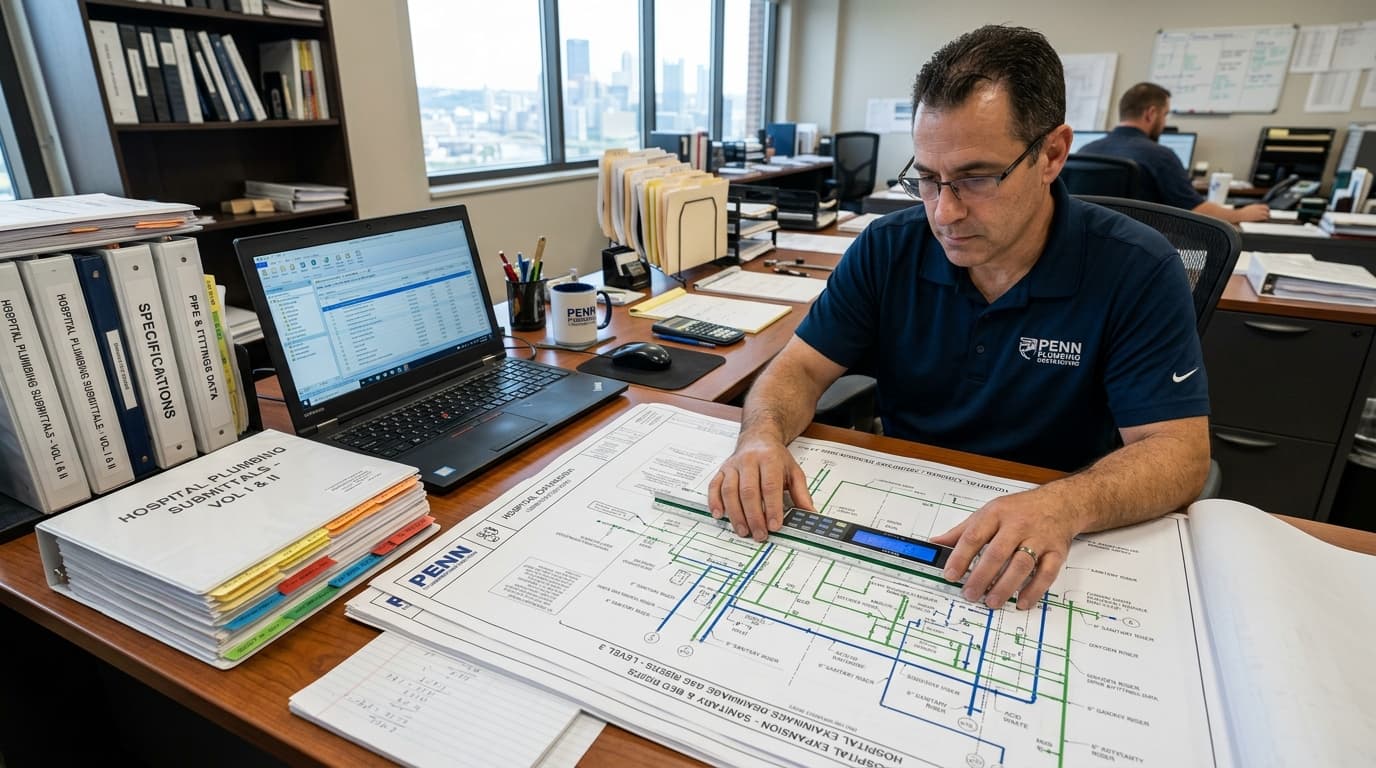
Images illustrate estimating subjects. They do not document our local office, a completed client project or local jobsite experience.
- ICC code adoption information and IAPMO adopted-code information
- Federal wage determination records; confirm any separate state/local requirements with the relevant authority.
- Reconcile civil and building plumbing plans
- Send the jurisdiction and drawings for a scope review
Quick State Facts • Pennsylvania Estimating Baselines
Pennsylvania Uniform Construction Code (UCC, Title 34 Pa. Code) based on the IPC; Philadelphia Plumbing Code (Subcode P); Allegheny County Health Dept Article XV
Pennsylvania Department of Labor & Industry (L&I), Philadelphia L&I, Allegheny County Health Department
City of Philadelphia Master Plumber License; Allegheny County Health Department Plumbing Division Licensing; Municipal licensing in third-class cities; no single statewide commercial plumbing license
Municipalities opt in to UCC or enforce local codes; independent county-wide plumbing department in Allegheny County; Philadelphia independent code
Frost penetration typically ranges from 30–36 inches in southeastern PA (Philadelphia) to 36–42 inches in central/western PA, and 42–48 inches in northern tier counties; subject to local AHJ ordinances and geotechnical verification
Greater Philadelphia (Philadelphia, Montgomery, Bucks, Delaware, Chester Counties), Greater Pittsburgh (Allegheny & Westmoreland Counties), Lehigh Valley Industrial Logistics Hub (Allentown / Bethlehem), Central Pennsylvania Capital Region (Harrisburg / Lancaster), Scranton / Wilkes-Barre Northeastern Corridor
Pennsylvania Plumbing Code & Regulatory Environment
Commercial plumbing in the Commonwealth of Pennsylvania is governed under the Pennsylvania Uniform Construction Code (UCC), codified in Title 34 Pa. Code Chapters 401–405, administered by the Pennsylvania Department of Labor & Industry (L&I). However, major home-rule jurisdictions enforce independent standards.
State Adoption Structure
The PA UCC incorporates the International Plumbing Code (IPC) with Pennsylvania-specific amendments. The City of Philadelphia enforces the Philadelphia Plumbing Code (Title 4 Subcode P), and Allegheny County enforces ACHD Article XV independently.
State vs. Local AHJ Authority
Municipalities may opt to administer the UCC locally or delegate enforcement to state-certified third-party inspection agencies. Allegheny County maintains an independent, county-wide plumbing department separate from municipal building code enforcement.
Key Statutory Plumbing Requirements:
- Commercial contractors must comply with municipal/county licensing requirements in Philadelphia, Pittsburgh, and certified third-class cities.
- Plan review submittal to certified municipal building departments, ACHD (in Allegheny County), or Philadelphia L&I.
- Backflow prevention assemblies must comply with local water purveyor cross-connection control programs (e.g. Philadelphia Water Department).
- Stormwater detention and green infrastructure compliance conforming to municipal runoff reduction ordinances.
Plumbing Estimating & Takeoff Scope Considerations in Pennsylvania
Itemized quantity takeoff protocols for commercial plumbing assemblies governed by Pennsylvania codes.
Type L copper tubing with ProPress or soldered joints, Type K for underground services, PEX distribution in multi-family projects, and PRV stations.
Schedule 40 PVC DWV in standard commercial builds; cast iron no-hub pipe in Philadelphia commercial risers, return-air plenums, and acoustic walls.
Interior rainwater conductors, primary and overflow roof drains, vertical leaders, and connections to civil stormwater detention vaults.
Schedule 40 black steel piping with welded joints on 2-1/2" and larger, corrugated stainless steel tubing (CSST) for terminal runs.
Commercial water closets with 1.28 GPF flush valves, high-efficiency urinals, ADA lavatories with sensor faucets, emergency eyewash stations.
Commercial gas-fired power-vent water heaters, tankless manifold arrays, thermal expansion tanks, and recirculation circulators.
Duplex domestic water booster pump skids, submersible sanitary sewage ejectors, and elevator sump pumps with oil-sensing switches.
Fiberglass pipe insulation with ASJ vapor retarder on cold water lines; thermal insulation on hot water and recirculation loops.
Trench excavation (30" to 48" cover), crushed stone bedding, laser-graded underground pipe installation, and backfill.
Regional Construction Conditions & Site Geotechnical Factors
Regional factors to confirm against the project geotechnical report, engineered details, and permit requirements.
Frost penetration averages 30 to 36 inches in southeastern Pennsylvania (Philadelphia), 36 to 42 inches in central and western Pennsylvania, and up to 48 inches in northern tier counties.
Lehigh and Cumberland valleys feature karst limestone topography with active sinkhole risks, requiring ductile iron piping or reinforced concrete cradles. Western Pennsylvania features shallow sandstone and shale bedrock requiring mechanical rock-hammering allowances.
Urban waterfront projects along the Delaware, Schuylkill, Allegheny, and Monongahela rivers encounter high groundwater tables requiring trench dewatering and sumps.
Pennsylvania is situated in low-to-moderate seismic hazard zones (Category A and B). Acidic coal-bearing soils in western Pennsylvania mandate protective polywrap encasement for underground metal piping.
Downtown Philadelphia and Pittsburgh involve dense urban site constraints, congested traffic corridors, and crane-hoist staging requirements.
Local Jurisdiction & Project Coverage Matrix
Commercial takeoff considerations across Pennsylvania's key economic centers, county seats, and metropolitan AHJs.
| Area / Market | Primary AHJ or Authority | Local Code / Amendment | Utility Considerations | Major Project Types | Estimating Considerations | Verification Source |
|---|---|---|---|---|---|---|
| City of Philadelphia (Philadelphia County) | Philadelphia Department of Licenses and Inspections (L&I) | Philadelphia Plumbing Code (Title 4 Subcode P) | Philadelphia Water Department (PWD) storm and sewer connection rules | High-rise commercial, healthcare complexes, university campuses | PWD stormwater regulations; mandatory cast iron soil pipe in commercial risers; backwater valves; UA Local 690 union rates | Philadelphia Department of Licenses and Inspections / PWD |
| Allegheny County (Pittsburgh Metroplex) | Allegheny County Health Department (ACHD) - Plumbing Division | ACHD Rules and Regulations Article XV (Plumbing) | Pittsburgh Water and Sewer Authority (PWSA) / PA American Water | Commercial office towers, robotics tech facilities, healthcare centers | Independent county-level plumbing permitting; steep slope drainage; sandstone bedrock excavation; UA Local 27 rates | Allegheny County Health Department Article XV |
| Montgomery County (King of Prussia / Norristown) | Municipal Building AHJs / Certified Third-Party Inspection Agencies | PA Uniform Construction Code (2018/2021 IPC Base) | Aqua Pennsylvania / Local municipal water authorities | Life sciences laboratories, commercial retail complexes, multi-family mid-rises | High-purity acid waste piping; commercial grease interceptor sizing; 36-inch frost depth | Pennsylvania Department of Labor & Industry UCC |
| Lehigh County (Allentown / Bethlehem) | City of Allentown Building Standards / Municipal AHJs | PA Uniform Construction Code | Lehigh County Authority (LCA) | Mega-logistics distribution centers, regional healthcare networks | Karst limestone terrain requiring sinkhole mitigation and flexible piping joints; massive roof drainage takeoffs | Lehigh County Authority / Municipal Building Departments |
| Dauphin County (Harrisburg Capital Metro) | City of Harrisburg Codes Bureau / Municipal AHJs | PA Uniform Construction Code | Capital Region Water | State government institutional complexes, commercial healthcare facilities | Central utility plant connections, backflow containment, domestic booster pumps | Capital Region Water / City of Harrisburg Codes Bureau |
Labor Environment & Prevailing Wage Considerations
How commercial mechanical contractors model labor productivity and regulatory wage determinations in Pennsylvania.
The Pennsylvania Prevailing Wage Act (43 P.S. § 165-1 et seq.) mandates prevailing minimum wage rates on public work projects funded by the Commonwealth or public bodies.
Prevailing wage applies when the total estimated cost of the entire public work project exceeds $25,000, determined by the Pennsylvania Department of Labor & Industry.
Federally assisted projects are subject to federal Davis-Bacon Act wage determinations published by the U.S. Department of Labor.
Greater Philadelphia (UA Local 690 Plumbers, UA Local 420 Steamfitters) and Greater Pittsburgh (UA Local 27 Plumbers, UA Local 449 Steamfitters) represent strong union markets. Central Pennsylvania and rural northern counties feature competitive open-shop participation.
Labor estimates must account for urban congestion in Philadelphia and Pittsburgh, multi-story hoisting, winter weather factors, and regional trade craft availability.
State-Specific Plumbing Estimating Workflow in Pennsylvania
The 9-step preconstruction process mechanical estimators follow to produce audit-ready bid deliverables.
Review architectural floor plans, civil utilities, plumbing fixture schedules, and mechanical specifications.
Determine applicable code: PA UCC statewide, Philadelphia Subcode P, or Allegheny County ACHD Article XV.
Itemize all commercial plumbing fixtures, carrier assemblies, commercial water heaters, and booster pumps.
Quantify linear footage of domestic water, sanitary DWV, storm conductors, and natural gas lines by size and spec.
Calculate excavation, trench box shoring, and crushed stone bedding based on verified regional frost depth (30" to 48").
Apply Pennsylvania Prevailing Wage determinations for public works over $25K, or open-shop/union commercial rates.
Obtain current local plumbing wholesale quotes for pipe, valves, fittings, and specialized equipment packages.
Clearly document trade cutoffs (e.g. 5 feet outside building wall, mechanical equipment connections).
Compile itemized Bill of Materials, labor hour summaries, and subcontractor proposal letters for GC submission.
Frequently Asked Questions • Pennsylvania Plumbing Estimating
Q:What plumbing code is used in Pennsylvania for commercial estimating?
Commercial plumbing in Pennsylvania is governed by the Pennsylvania Uniform Construction Code (UCC) based on the International Plumbing Code (IPC). However, the City of Philadelphia enforces its own Philadelphia Plumbing Code (Subcode P), and Allegheny County enforces ACHD Article XV.
Q:Who licenses commercial plumbers in Pennsylvania?
Pennsylvania does not have a single statewide commercial plumbing license. Licensing is governed locally by municipalities and counties, including the Philadelphia Department of Licenses and Inspections and the Allegheny County Health Department.
Q:What is the required frost depth in Pennsylvania for plumbing takeoffs?
Frost penetration typically ranges from 30 to 36 inches in southeastern PA (Philadelphia), 36 to 42 inches in central and western PA, and up to 48 inches in northern tier counties, subject to local AHJ verification.
Q:When is prevailing wage mandatory in Pennsylvania?
Under the Pennsylvania Prevailing Wage Act, prevailing wages are required on any public work project funded by the state or public authority where the total estimated contract cost exceeds $25,000.
Q:What documents are required for a Pennsylvania commercial plumbing estimate?
Estimators require architectural floor plans, civil site utility plans, plumbing fixture schedules, riser isometric diagrams, structural foundation drawings, and Division 22 written project specifications.
Request a Detailed Plumbing Estimate in Pennsylvania
Submit your drawing set and specifications. We review civil utility tie-ins, riser isometric diagrams, and local AHJ codes to provide an itemized Bill of Materials and MCAA labor estimate on the agreed schedule.
Bidding Commercial Work in Pennsylvania?
We prepare complete CSI Division 22 takeoff packages formatted for quick review and direct bid day submission.
Instant Quote Calculator
Estimate your Pennsylvania project turnaround and pricing.
Share your scope and bid deadline. Pricing and delivery dates are confirmed after drawing review.